
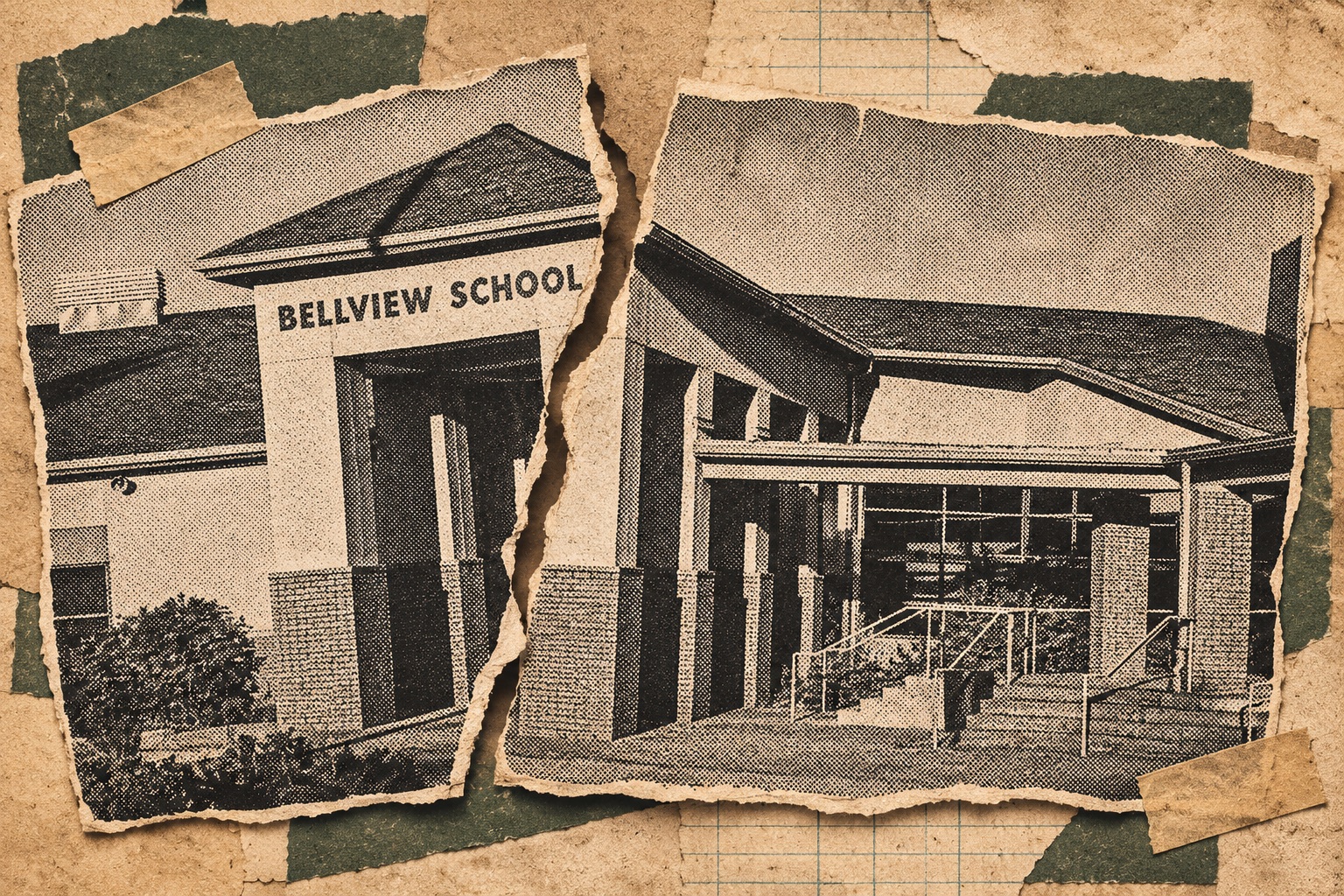
 Art by CONTRA
Fourth-Grade Math
November 18, 2026 · by Nixie Worthington
The Ashland School District is talking about closing Bellview Elementary and TRAILS Outdoor School in a bid to save $4.834 million a year. Two-thirds of that number is labeled “reported ongoing baseline savings” that isn’t explained in any public document. By my most charitable reckoning, the two closures supply somewhere between 1/10th and 2/5ths of the money. The district hasn’t estimated how many families it might lose in the process, though we know that every child who leaves takes about $13,300 a year of state money out the door with them. The superintendent promised this decision in January, but it’s now penciled in for December, with Thanksgiving in the way. Here’s the full story, as we understand it.
This is a developing story, and the paper will follow it as the district answers questions and publishes the records it has said it needs. Alan Decault, the paper’s public records editor, was research assistant on this piece. The Sunday Edition is also running on a Wednesday, because the district moved its calendar up and ours had to follow.
The plan would close Bellview, with 242 students, and TRAILS, with 114, and send the children to Walker, Helman and the middle school in the fall of 2027. Nobody has voted on it, which has not stopped 356 children and their families from receiving an early Christmas present in the form of the possibility that their schools will cease to exist. Raising it this early, on numbers this thin, was premature, and the town has noticed. Ashleigh Cropper, co-president of the Bellview PTO, told David Runkel of the Ashland Chronicle in a story published November 17 how the news went over at home.
“My children cried when I sat them down tonight and told them they both wouldn’t be in the same school next year.”
Enrollment Has Declined Over Several Years
That header is the district’s own, from page 5 of the proposal, and on this point the district is right. The October count has gone from 2,922 in 2017–18 to 2,368 this fall, with worse projected.
Figure 1
Fewer students, and fewer than forecast
October enrollment and the district’s planning projection · earlier forecasts in grey
The record holds no October count for 2020–21, so that stretch is bridged with a dotted line. The proposal’s own peak figure for 2017–18 is 2,950, from a different count. A projection is a planning assumption, not an enrollment.
The numbers
| Year | October count | District projection | PSU 2017 (low) | FLO 2022 (middle) |
|---|---|---|---|---|
| 2017–18 | 2,922 | — | — | — |
| 2018–19 | 2,897 | — | — | — |
| 2019–20 | 2,835 | — | — | — |
| 2020–21 | — | — | 2,672 | — |
| 2021–22 | 2,487 | — | 2,695 | — |
| 2022–23 | 2,563 | — | 2,681 | 2,576 |
| 2023–24 | 2,553 | — | 2,667 | 2,541 |
| 2024–25 | 2,507 | — | 2,682 | 2,515 |
| 2025–26 | 2,425 | — | 2,679 | 2,492 |
| 2026–27 | 2,368 | 2,368 | 2,719 | 2,455 |
| 2027–28 | — | 2,290 | — | — |
| 2028–29 | — | 2,212 | — | — |
| 2029–30 | — | 2,135 | — | — |
| 2030–31 | — | 2,057 | — | — |
Very little of that has to do with the schools. Births to residents of the 97520 ZIP code are down by about a fifth since the middle of the last decade, the median Ashland house costs eight and a half times the median household income, and the open-enrollment students who used to come in from neighboring districts have dwindled from 329 to roughly a hundred. For twenty years Ashland has been busily turning itself into a lovely place to finish a life and an increasingly ridiculous place to begin one, and at this rate we may end up a retirement community with a theater festival and a few ceremonial children. The district didn’t create that, but closing neighborhood schools seems an odd way to answer it.
Oregon pays a district on a weighted count of its students, subtracts the district’s own property taxes and sends the difference from Salem, so when the children go the money goes with them, however much the town pays in tax. Ashland’s permanent-rate school taxes rose 23 percent from 2018–19 to 2024–25 and the local option levy you renewed in May rose 27 percent, while the count of students the state pays for fell 12 percent.
Figure 2
Local taxes went up. The students the state pays for went down.
Index, 2018–19 = 100 · hover or tap for the year
Permanent-rate taxes are subtracted inside the state formula, so a rise mostly lowers the state grant. The levy sits outside the formula and adds money. Bond levies pay only debt and are not shown.
The numbers
| Year | Permanent-rate tax | Local option levy | Funded students (ext. ADMw) |
|---|---|---|---|
| 2018–19 | $13,677,285 | $3,721,350 | 3,331.83 |
| 2019–20 | $14,268,020 | $3,806,921 | 3,307.46 |
| 2020–21 | $15,462,410 | $3,993,679 | 3,270.87 |
| 2021–22 | $15,658,735 | $4,222,665 | 2,900.94 |
| 2022–23 | $16,283,736 | $4,542,837 | 2,929.58 |
| 2023–24 | $16,680,237 | $4,796,030 | 2,929.58 |
| 2024–25 | $16,863,895 | $4,720,827 | 2,921.40 |
There is a genuine budget problem, and the paper isn’t going to pretend otherwise. Starting from the district’s own September numbers, the independent review behind this piece projects a General Fund shortfall of about $3.4 million by 2030–31 if nothing changes, with the reserve falling below the board’s 8 percent minimum in 2027–28, and that requires action over the next two budgets. It doesn’t require panic this winter. The district projects an 8.24 percent reserve at the end of this school year with every school still open, and the “budget deficit of nearly $8 million” on page 4 of the proposal is an old projection of what would have happened without the 2024–25 cuts. There’s a difference between a looming problem and a five-alarm fire, and it is generally considered wise to establish which one you are dealing with before demolishing the firehouse.
Ashland has been busily turning itself into a lovely place to finish a life and an increasingly ridiculous place to begin one.
The $4.834 Million Question
The district’s case is a table on page 20 of the proposal, printed as a picture: $3.4 million of unexplained baseline savings, $1.901 million of additional staffing reductions, less $467,000 of recurring new costs.
Figure 3
The anatomy of $4.834 million
The district’s table on page 20, then how much of it depends on closing Bellview and TRAILS
- Reported ongoing baseline savingsDefined in no public record+$3.400M
- Listed additional staffing reductionsNo position or site list published+$1.901M
- Total gross ongoing savings$5.301M
- Recurring additions / reinvestmentsStaff “to account for larger elementary schools”−$0.467M
- Estimated net recurring annual savings$4.834M
- One-time moving allowanceThe only one-time cost listed−$0.100M
- Estimated first-year net savings$4.734M
What closing the two schools saves, net, per year · independent estimates
- Low estimate−$0.18Ma net cost
- Central estimate$0.52M11% of $4.834M
- Corvallis-scaled peer check$0.81M17% of $4.834M
- High estimate$1.32M27% of $4.834M
- District-friendly bound$2.16M45% of $4.834M
The district calls every figure in its table preliminary (p.20, p.23). The closure estimates are this paper’s independent model built from state site-level spending, not district figures, and the district holds better data. The district-friendly bound counts every listed staffing cut as caused by the closures.
The arithmetic works, and whether the savings exist, or which of them need a school closed, is a good deal less clear. The $3.4 million is defined in none of the 66 School Board meetings posted to BoardBook since February 2024 and in none of the 27 documents on the district’s transformation pages. Nobody has published a list of the jobs behind the $1.901 million, and the only one-time cost anywhere is $100,000 for moving. To its credit, the district says as much, in a paragraph under the table that deserves to be read whole.
“Transportation changes, building modifications, partner operations, intervention supports, calendar changes, final staffing model, and program development can affect the result. Any additional recurring cost reduces net recurring savings. Bellview partner funding and future TRAILS-center revenue cannot be guaranteed before agreements exist. A role-by-role staffing schedule and an updated multiyear forecast are needed to demonstrate how the plan balances costs and revenues. The figures presented here communicate the financial scale of the proposal while identifying the work still needed to establish a dependable final estimate which will require a long runway for implementation.”
A long runway, and a December vote, which as far as I can tell means building the runway after takeoff. The same page warns against counting old savings twice, excellent advice from an organization that hasn’t explained what it is counting. The “approximately $2.229 million” the district credits to 2024–25 included $824,000 of furlough days and a line in the action plan that reads “Anonymous donor +$890,000,” and the 27 positions cut in Phase 2 are already gone from the budget. If any of that is hiding inside the baseline, the plan is spending the same dollar twice. State records also show $3,473,000 of 2024–25 General Fund spending assigned to the Bellview and TRAILS sites, suspiciously close to the unexplained $3.4 million. It could be coincidence, and the district hasn’t said.
The trouble with treating a school’s budget as savings is that closing a building doesn’t eliminate the cost of teaching the children inside it. The teachers go where the students go, and so do most of the expenses. You might lose a principal, an office, some custodial work and some utilities, but you do not eliminate fourth-grade math by moving fourth grade across town, and Ashland’s classrooms are already full enough that the proposal plans 31 elementary homerooms for 2027–28 against 32 in October 2025.
Figure 4
What each school costs per student, and what closing one saves
State figures, all funds, per student including district-wide costs · 2024–25 shown
Willow Wind does not appear as a school in any state school-level report from 2019–20 to 2024–25, so the district’s claim that TRAILS costs “nearly 12%” more per pupil cannot be checked against these figures.
A school’s cost is not what closing it saves
- Bellview · $6.11M in 2024–25$640,000 avoidable, about 10%
- TRAILS · $3.34M in 2024–25$335,000 avoidable, about 10%
The numbers
| School | 2019–20 | 2020–21 | 2021–22 | 2022–23 | 2023–24 | 2024–25 |
|---|---|---|---|---|---|---|
| Bellview | $15,487 | $18,914 | $23,062 | $23,612 | $22,618 | $21,829 |
| Helman | $15,908 | $19,583 | $23,722 | $22,523 | $22,313 | $22,351 |
| Walker | $15,796 | $19,728 | $24,419 | $24,402 | $20,830 | $19,381 |
| TRAILS | $14,913 | $19,319 | $20,687 | $22,120 | $22,109 | $20,939 |
| Middle School | $17,327 | $18,995 | $22,162 | $21,960 | $21,526 | $21,358 |
| High School | $17,564 | $19,149 | $23,435 | $23,448 | $23,817 | $23,333 |
Built from the state’s site-level spending records, the independent model puts the two closures’ savings at roughly $520,000 a year, in a range that runs from a small net loss to $1.32 million. Even an exceptionally generous calculation, which assigns every listed staffing reduction to the closures, reaches only about $2.16 million. Those are estimates and not district figures, and the district has better information, which it hasn’t released. The rest of the advertised savings comes from changes at the middle school, the high school and the central office that nobody has shown to require closing either school, which leaves the two schools on the list for reasons the proposal doesn’t give. The proposal does claim TRAILS costs “nearly 12%” more per student than Willow Wind, but the state’s school-level reports have never identified Willow Wind separately, so the comparison can’t be checked, and the same reports show TRAILS costing less per student than Bellview or Helman.
Enrollment Decline Risk
Last July a director of this same board, arguing for an affordable housing tax break, put the arithmetic better than I can, and this paper printed it at the time: “affordable housing generates more students for us than other types of housing, and one student added is more revenue for the district than that property tax hit.”
It runs the other way too, and that is the flaw in assuming closures save money. Some families leave, and Oregon funds schools by enrollment. Each resident student who departs costs Ashland about $13,300 a year in formula revenue, or about $12,700 net of the little a scattered departure saves, starting the year after they go.
Figure 5
How many lost students would cancel the closures’ savings?
Accounting thresholds, not forecasts · each departing resident student costs about $12,700 a year, net, from 2028–29
- Low estimatea net costCancelled at zero: no net saving to protect
- Central estimate$0.52M a yearBreak-even at about 42 students
- Corvallis-scaled peer check$0.81M a yearBreak-even at about 66 students
- High estimate$1.32M a yearBreak-even at about 107 students
- District-friendly bound$2.16M a yearBreak-even at about 176 students
Against the district’s whole $4.834 million the break-even would be about 390 students, but most of that money does not depend on closing a school. Departures in fall 2027 first cost money in 2028–29 because Oregon funds a district on the higher of this year’s or last year’s count. Nobody, including the district, has estimated how many families would actually leave.
At the central estimate, 42 departing students erase the annual savings from closing both schools, and under the most closure-friendly assumptions the figure rises to about 176. The district has offered no estimate of how many students might leave, which is peculiar, since its own board materials warned in November 2025 that “Perception of instability may influence family decisions.” Families already leave for private schools, home schooling and online charters, 24 and then 26 and then 36 over the last three reported summers. TRAILS parents chose an outdoor school on purpose, and telling them their replacement option is the Willow Wind lottery is not exactly a retention strategy. One TRAILS parent, in a response to Councilor Dylan Bloom’s public letter that reached this paper, said some families will simply leave, and I believe it.
A Stanford study of California districts found that closures on average failed to produce net financial gains, largely because enrollment revenue fell alongside expenses. California isn’t Oregon and the study doesn’t prove closures never work, but it does suggest somebody ought to run the numbers before declaring victory. Corvallis closed two schools in June and enrolled 143 fewer students this fall than it had budgeted for, which Corvallis hasn’t attributed to the closures and which is hardly reassuring either. In Bethel, closing an elementary school Bellview’s size was followed by $595,330 of extra teaching costs at the receiving schools in the first fall alone. Closures can save money, and you find out how much only after counting what they cost, which should not take a newspaper to explain.
Operate Two K–5 Schools
The district’s proposal describes operating two K–5 schools as “a substantial alternative with fewer transitions for children and potentially simpler sibling routines,” then declines to put a price on it, or on any other alternative. So the review did, comparing four configurations over five years and keeping in each the proposed savings that don’t depend on closing a school.
Figure 6
Four ways to close the gap, priced over five years
General Fund improvement against doing nothing, 2027–28 to 2031–32 · longest bar is best for the budget
Closure-skepticalClosure savings at the low estimate, 100 departures under the district plan
CentralCentral estimates throughout
Closure-friendlyDistrict-friendly savings, 10 departures
Every scenario keeps the parts of the plan that do not depend on closing a school, and every one closes the projected 2030–31 gap. Only A carries a district figure. B, C and D are independent estimates; the district published no cost for any alternative. The ranking flips inside the range the record allows.
Under central assumptions the district’s plan improves the General Fund by $23.2 million and keeping both Bellview and TRAILS open improves it by $23.7 million, half a million dollars in favor of the schools. Change the assumptions about staffing savings and departing families and the results swing by millions in either direction, though every alternative modeled still closes the projected 2030–31 gap. The district’s actual staffing data could move these numbers a long way. Until it is published, keeping both schools open is a financially defensible option, not an emotional indulgence or a refusal to face arithmetic.
Some Families Will Have Children At Different Elementary Campuses
That is from page 18 of the proposal, which concedes that “the proposed educational benefits do not erase those concerns.” Grade bands would force a school change between second and third grade, and some families would have children at Walker and Helman at once, with tentative bells ten minutes apart and bus routes still unplanned. Seventh and eighth graders would lose Spanish from their core schedule, the Mountain team would end in its current form, and in most months Wednesday early release would become a full day without school and without a childcare plan. TRAILS’s outdoor practices would, we are told, inform learning across the district, on no fixed schedule, which in administrative English is called preserving educational benefits and in ordinary English sounds rather like eliminating a program and retaining its adjectives.
Willow Wind is a public alternative program, and some of its families wrote to say it is the reason they stayed in the district at all, which puts them on the same side of this as Bellview and TRAILS. Councilor Bloom, writing as a parent and one councilor rather than for the Council, has asked that every program be held to the same standard of cost, admission and results. Bloom also passed along accounts from families who believe children with IEPs or 504 plans were discouraged from enrolling there, which nobody has substantiated, and the district says students with disabilities are eligible for its lottery.
Keeping both schools open is a financially defensible option, not an emotional indulgence or a refusal to face arithmetic.
Bellview might become an early learning center, assuming a partner agrees to run it without General Fund support, and nobody has signed that agreement. TRAILS could sit empty for a year while “those costs must remain in the budget.” Neither expense appears in the savings table, which closes on the only exclamation point in twenty-four pages: “Continued improvements in our financial outlook is the added benefit!” One admires the enthusiasm more than the accounting.
Not A Sprint
On April 9, Superintendent Joseph Hattrick told the School Board there would be no final decision before January 2027, said it twice, and called the pace “Not a sprint, where decisions are rushed, and not a standstill, where we avoid necessary change.”
Some time before September 14, the superintendent’s letter to the community promised a session at every school in October and November “to share the scenarios, the criteria that will be used to evaluate them, and transparent estimates of the financial impact of each option,” and said the board was “tentatively scheduled to make a decision in January.” The Transformation Guide posted on the district’s website scheduled board approval for January through March 2027.
On November 16 the public received one configuration, one savings figure and a proposal that says the board will act in December, citing that same guide.
Figure 7
From “no decision before January” to December
April 2026 to March 2027 · the decision window then and now
Roadmap presented: no final decision before January 2027. Phase-one data held back until the survey closes.
Steering committee, 38 members, is walked through the phase-one data.
Community survey closes: 556 respondents, 981 written answers.
Superintendent’s letter: “transparent estimates of the financial impact of each option” at every school in October and November; board decision “tentatively scheduled” for January.
Transformation Guide, as posted: “comprehensive impact analyses” of each scenario. Board approval January to March 2027.
One configuration, one savings figure. “Specific dates have evolved.” Board action anticipated December 2026.
Nov. 17, 18 and 23, each at 6 p.m.: AHS theater, AMS Commons, AHS theater.
Regular meeting, 6:30 p.m. Preliminary transformation presentation, no action scheduled.
Thanksgiving.
Next regular meeting. Twenty-four days after the proposal was released.
The proposal cites the Transformation Guide for a December decision. The copy of the guide posted on the district’s transformation page schedules board approval for January through March 2027. All 2026 unless marked.
The proposal explains that “Specific dates have evolved as the work has progressed.” Evolution generally takes several generations, and this one took a few weeks and skipped the part involving evidence. The next regular board meeting is December 10, twenty-four days after the proposal appeared, with Thanksgiving in the middle, and while no closure vote is on a posted agenda yet, the decision window has plainly moved. The copy of the guide the proposal links to sits on a staff OneDrive the public cannot open, so if the guide was revised, nobody has posted the revision.
Show Your Work
The district’s own FAQ asks whether nearly five million dollars in savings is guaranteed, and answers no. This isn’t an argument for ignoring falling enrollment or against cutting costs. It is an argument against closing schools on the strength of unverified savings and a calendar that has suddenly developed a sense of urgency, and the five elected directors should insist on answers before they consider any closure:
- What exactly is the $3.4 million baseline, and does it count savings already taken?
- Which staffing reductions actually depend on closing Bellview and TRAILS?
- How many students does the district expect to lose, and what will those departures cost?
- What do the alternatives cost, including keeping both schools open?
- Who pays for the buildings, transportation and transition costs not yet included?
- Who moved the promised January decision into December?
Take the closures off the December agenda. Publish the staffing schedule and the multiyear forecast, price the alternatives, and let the public look at the numbers. Make the reductions that stand on their own merits, and if closing a school still proves necessary after that, come back with the evidence. The superintendent’s letter said January, and the directors can hold the district to it.
So much of this comes back to what it costs to live here, and that comes back to housing. A median Ashland house costs eight and a half times what the median household earns, against less than six times across Jackson County. The city has permitted about sixty-two homes a year since 2010, most of them single-family, and fewer than half the houses in the district have three bedrooms, against about six in ten countywide. Read the enrollment chart from that end and it stops being a mystery: the median resident of the district is now past forty-eight, and fewer than one household in five has a child in it, against more than one in four in the county as a whole.
No school board can build an apartment building, and the district doesn’t write the town’s housing rules. But this board heard one of its own directors say in July that affordable housing brings in more students than any other kind, and the city was in the same room asking the board to help exempt exactly that housing from school taxes. The conversation between the city and the district about where the next families are going to live is the one worth having this winter, starting with the exemption the city asked for in July.
Closing their schools, meanwhile, makes the town less attractive to the families who have managed to stay, which is a curious response to all of it. We have plenty of reasons to retire in Ashland. We’re running short of reasons to raise children here, and Bellview and TRAILS are two of them.
Public Meetings
Town halls are scheduled for tonight, November 18, at 6 p.m. in the Ashland Middle School Commons, and November 23 at 6 p.m. in the Ashland High School theater. The School Board meets November 19 at 6:30 p.m., with no action scheduled, and again December 10. Public comment runs under the board’s own sign-up rules, so check the district’s current agendas before attending, and the proposal links a feedback form for anyone who would rather put it in writing.
Sources: the Ashland School District’s Community Transformation Proposal of November 16, 2026, and its executive summary; the district’s Transformation Guide as posted on its website; the superintendent’s letter to the community published ahead of the steering committee’s September 14 meeting; School Board packets and minutes posted to BoardBook from February 2024 through October 22, 2026, including the November 13, 2025 process recommendation, the 2026–27 budget message and the October 8, 2026 financial report; the district’s audits for 2023–24 and 2024–25; the Oregon Department of Education’s State School Fund estimates through November 16, 2026, its revenue and expenditure files and its school-level spending reports for 2019–20 through 2024–25; Corvallis and Bethel school board and budget documents; and Francis A. Pearman II, “The Fiscal Consequences of School Closures in California” (Getting Down to Facts, 2026). Alan Decault, the paper’s public records editor, was research assistant and assembled the district record and the independent model behind the savings estimates, the break-even counts, the forecast and the four scenarios. Those are estimates with ranges, the district holds better data than any of them use, and where the district publishes its staffing schedule or site budgets, its documents control. Ashleigh Cropper’s words are as the Ashland Chronicle reported them on November 17. Parents whose responses to Councilor Bloom’s public letter reached the paper are not named, because none of them wrote to us for publication, and their views are their own and not a survey. The opinions are mine. The questions above are open, and the paper will print the district’s answers as they come.