
Civic Beat · October 5, 2026 · by Nixie Worthington
Let It Go To The People
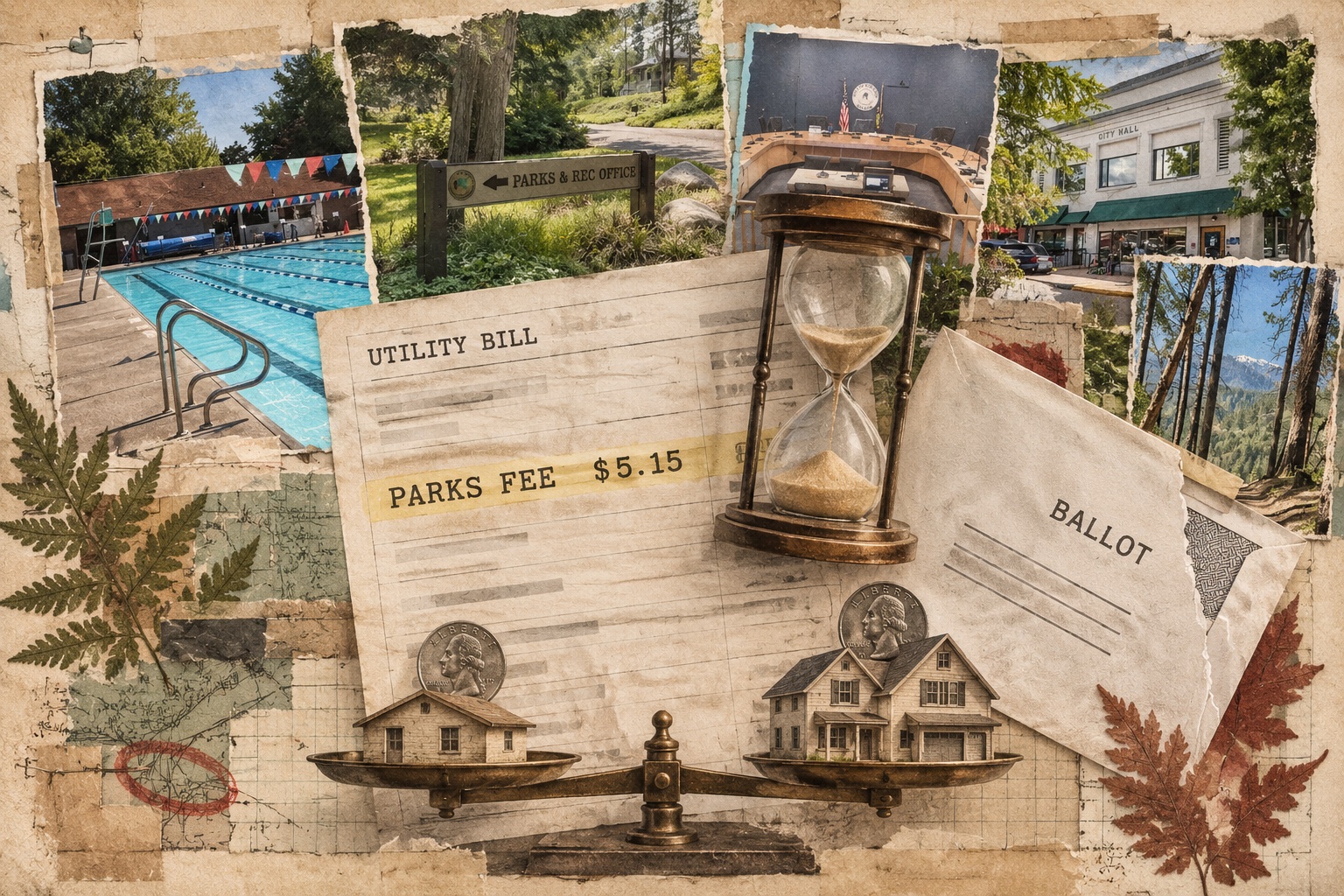
Three people signed up to speak at the public hearing on Ashland’s parks fee on Monday night, September 14, and two of them came. The third was Mike Gardiner, vice chair of the Parks and Recreation Commission and president of the Ashland Parks Foundation, and when the mayor called his name he was not in the room.
The hearing was the last public step before the council votes on October 6 whether to renew the fee. It is $5.15 a month on every household’s utility bill. The council created it in May 2025 by Resolution 2025-13, and it ends on its own on June 30, 2027 unless the council renews it. It raises about $750,000 a year, which staff say all goes to the Parks and Recreation Department and covers about 10 percent of that department’s operating budget. The paper has written about this fee twice before, most recently in Five Dollars and Fifteen Cents.
The Gap
Deputy City Manager Jordan Rooklyn gave the budget picture first, with the word “Preliminary!” on the slide, exclamation point included. The city’s general fund will need to cut about $2 million a year in the next biennium to match its spending to its income. Without the parks fee, the staff memo says, that becomes “roughly $2.5-$2.75 million a year.” The slide says $2.75 million, and the memo the Parks Commission received on September 4 said $2.5 million. If the fee ends, staff estimate the Parks Department alone would lose $400,000 to $500,000 a year, unless the council takes that money out of police, fire or planning instead.
Councilor Jeff Dahle asked what 10 percent of a parks budget actually buys, because, he said, the percentages meant nothing to him. Rooklyn gave him the list. “The senior services plus the nature center plus our recreation programming,” she said. “I would say you add ’em all up and that equals 750,000 more or less.” She added that she had left that detail out of the presentation on purpose, because where cuts fall inside Parks “is a park commission decision.”
Five days earlier she had given the Parks Commission the same reason for keeping the detail from the council. “I wanna be really cautious and careful of not giving city council that level of detail,” she told the commissioners on September 9, “because that rests in your all’s hands.”
Councilor Bob Kaplan pointed out that the last budget was balanced partly with one-time money from the general fund’s reserve. “That doesn’t solve a structural deficit,” he said. “The only way you solve a structural deficit is to make a structural change.” Councilor Dylan Bloom, reading from the adopted budget, said the Parks Department’s budget had grown by less than the fee collected, and that people change their minds about the fee “when they find out that out of $750,000 only about 500,000 is going to parks.” Mayor Tonya Graham disagreed and said “the entirety of the fees that are collected are spent on parks.” Both can be true if the general fund’s own share of the parks budget shrank after the fee came in, which is what Bloom’s figures suggest.
Six Hundred And Twenty-Three
The city’s survey closed the day of the meeting, and Rooklyn apologized for slides built that afternoon. It drew 623 complete responses, all but about thirty-three of them from Ashland, and 71 percent of the Ashland respondents want the fee renewed, she said. Both the yes and the no voters preferred a flat fee to a tiered one, and she said 61 percent of the no voters still wanted a waiver for low-income households. Bloom pointed out that 623 people is less than 3 percent of the town. Rooklyn said it was a much higher turnout than city surveys usually get, and somebody on the dais said “Ouch.”
The two speakers who came gave the council opposite advice. Linda Adams, a resident, read a tribute to parks as the town’s “green lungs” and asked the council to keep paying for them. George Kramer asked it to wait for the voters. Kramer led the petition campaign behind Measure 15-243, the charter amendment on the November ballot, as Jefferson Public Radio has reported. The measure would require voter approval for most new or increased fees on utility bills that have nothing to do with providing the utility service itself. Whether it would apply to renewing an existing fee is a question for the city attorney, and nobody asked it on Monday.
“You all created the sunset on the parks fee. We didn’t create it. You set timing for it to be a year long or two years long, sorry, expiring at the end of next year. That wasn’t our doing. It might not have been well timed in terms of the budget process and it might make your lives complicated and or staff’s lives complicated. But for that, I’m sorry. But the fact of the matter is, is that there is a ballot measure 15-243 that will be on the ballot in November that would specifically respond to this sort of precipitous action. And it is rude and disrespectful if this council takes a temporary fee and with four votes makes it permanent while the people of Ashland are waiting to weigh in.”
He added that Ashland would vote for a parks fee “if they thought it was all going to the Ashland Parks Department. We don’t have that confidence in you. It doesn’t sound like some of you have that confidence either.” He pointed to the school district’s youth activities levy, which comes back to the voters every two years and has passed every time.
Rooklyn had already explained the problem with waiting. The next budget starts July 1, 2027, the day after the fee ends. If the decision goes to the voters, the earliest election is in May, when the budget committee will already have recommended a budget, and any new money would have to be added partway through the year.
Around The Table
At the end of the night the council asked staff for options. Every councilor who spoke wanted a waiver for low-income households. The 495 households in the city’s utility assistance program already get 30 percent off their electric, water and wastewater rates, but not off the parks, public safety and wildfire fees, which together come to about $17.50 a month. Waiving the parks fee for all 495 would cost $30,591 a year. The council also asked for a version tiered by property type, the only kind the billing software can do. Staff’s own slide says that version will miss low-income households in single-family homes and ADUs, and Kaplan said tiers were too complicated to be worth it. The city’s slide said: “a household making $30K is paying the same monthly amount as a household making $200K.”
On the sunset, the council split. Bloom said he would vote yes on October 6 “only” if the sunset were extended to June 30, 2029, and would vote no on a permanent fee. He also said the council was “being rushed into this on the sixth.” Dahle said he had voted for the sunset in 2025 not to kill the fee but “to be able to actually have and be under a certain clock, so to speak, to do the work collectively so that we could prove that the value was still there.” He suggested staggering renewals so each fee comes up for review on its own cycle. The mayor said that was why she had supported the sunset too.
Councilor Gina DuQuenne wanted the 2027 sunset left alone.
“This body in June voted and supported this sunset. So in planning for the budget, and I’m glad that we are giving ourself this long runway for the budget planning, I really don’t know why we’re having this conversation because it sunsets in 2027 per the council’s vote. So to bring this back and say, well let’s look at it this way. It’s like, well, you know, we already voted on it and this is the way it is. … I don’t support making it permanent. I support what we voted on, sunset in 2027. Let it go to the people, let the people vote on it.”
When the mayor went around the table one last time, Bloom said he was only interested in extending the sunset. The next councilor said he was interested in extending it. The recording labels that voice ambiguously, but by the order of the round it was Councilor Derek Sherrell. Dahle said he was “interested in having a conversation. Always.” Kaplan said “me too.” DuQuenne said she was in favor of leaving it as it is. Councilor Eric Hansen said “discussion.” The meeting was adjourned at about half past seven.
What Staff Sent Back
The resolution the council will vote on comes in the packet for October 6. It is Resolution 2026-24, and it renews the fee at $5.15 a month starting June 30, 2027, with no end date. The 2025 resolution ran until June 30, 2027, “after which it will automatically expire unless renewed by the City Council,” and the minutes of that vote in May 2025 record why it had an end date at all. “Hansen and Kaplan will support the fee regardless of time limit or not. Bloom and Dahle will only support the fee with a time limit.” It passed four to one, with DuQuenne voting no. The staff report says the council asked on September 14 for a resolution renewing the fee, a waiver and a tiered option, and it supplies all three, but it offers no version with a new end date, the only version Bloom said that night he would vote for.
The resolution keeps the inflation clause the council wrote into its utility fees in 2025. Each July the fee goes up by the change in the West Region consumer price index, up to 5 percent, and anything above that needs a council vote. That clause is how $5 became $5.15 this July. The waiver is in it too, for the households in the utility assistance program, at no less than half the fee, with the actual discount to be set later by a separate resolution. Half off for all 495 households would cost $15,295.50 a year. Staff drew the tiered version and recommended against it, saying it would miss the households the council meant it for and that the survey disliked it. Staff now put the fee at $763,230 for the coming year.
Section 4 of the resolution declares the fee “a utility service charge and not a tax,” owed “solely from the use of and connection to City electric utility services.” Measure 15-243, as Jefferson Public Radio has described it, would put to the voters any new or increased fee on a utility bill that has nothing to do with providing the utility service.
What Should Happen
Renew the fee on October 6, with the waiver, and with a sunset on June 30, 2029, which means amending Section 1 of the resolution in the packet, because as written it never ends. That is Bloom’s condition and it is the right one. The sunset is why this council spent a September night asking what the fee buys, and a permanent fee would not bring it back to that question. A two-year renewal also lines the fee up with the budget, which fixes the timing problem Rooklyn described.
Kramer is right that making the fee permanent four weeks before the charter vote would be rude. But letting the fee lapse without a plan would cost the people who use the senior center, the pool and the nature center. Letting it run forever without review would keep the $30,000 households paying what the $200,000 households pay. A waiver and a new sunset take care of both, and the council can vote for them in one amended motion.
Sources: the caption transcript of the September 14, 2026 Ashland City Council study session and the 25-page packet published for it, which carries Rooklyn’s staff memos and slide deck. The survey figures, other than the 623 responses, come from slides that appear in the packet only as pictures, so they are reported as Rooklyn read them aloud and should be treated as preliminary until the final deck is attached to the minutes. Bloom’s figures from the adopted budget are described but not printed, because they are in no document the paper can check them against. The Parks Commission quotation is from the caption transcript of its September 9 meeting, and the $2.5 million figure from the memo in that meeting’s packet. The measure’s number, its terms and Kramer’s role in the petition are from Jefferson Public Radio’s report of September 11. The last round of the meeting is attributed by the order in which the mayor called on councilors: the caption software gives Councilors Sherrell and Hansen the same label, and folds Kaplan’s and Hansen’s one-word answers into the mayor’s own turn. Quotations are as transcribed, with the software’s mistakes fixed and the speakers’ own kept. The section on Resolution 2026-24 was added the day this piece ran, once the packet for the October 6 meeting was out. It rests on that packet’s staff report and resolution text, and on the May 2025 council minutes, which carry the time limit and the four-to-one vote. The staff report gives the cost of a full waiver as $30,951. Four hundred and ninety-five households at $5.15 a month comes to $30,591, which is the figure the September packet used, and the paper has kept it.