
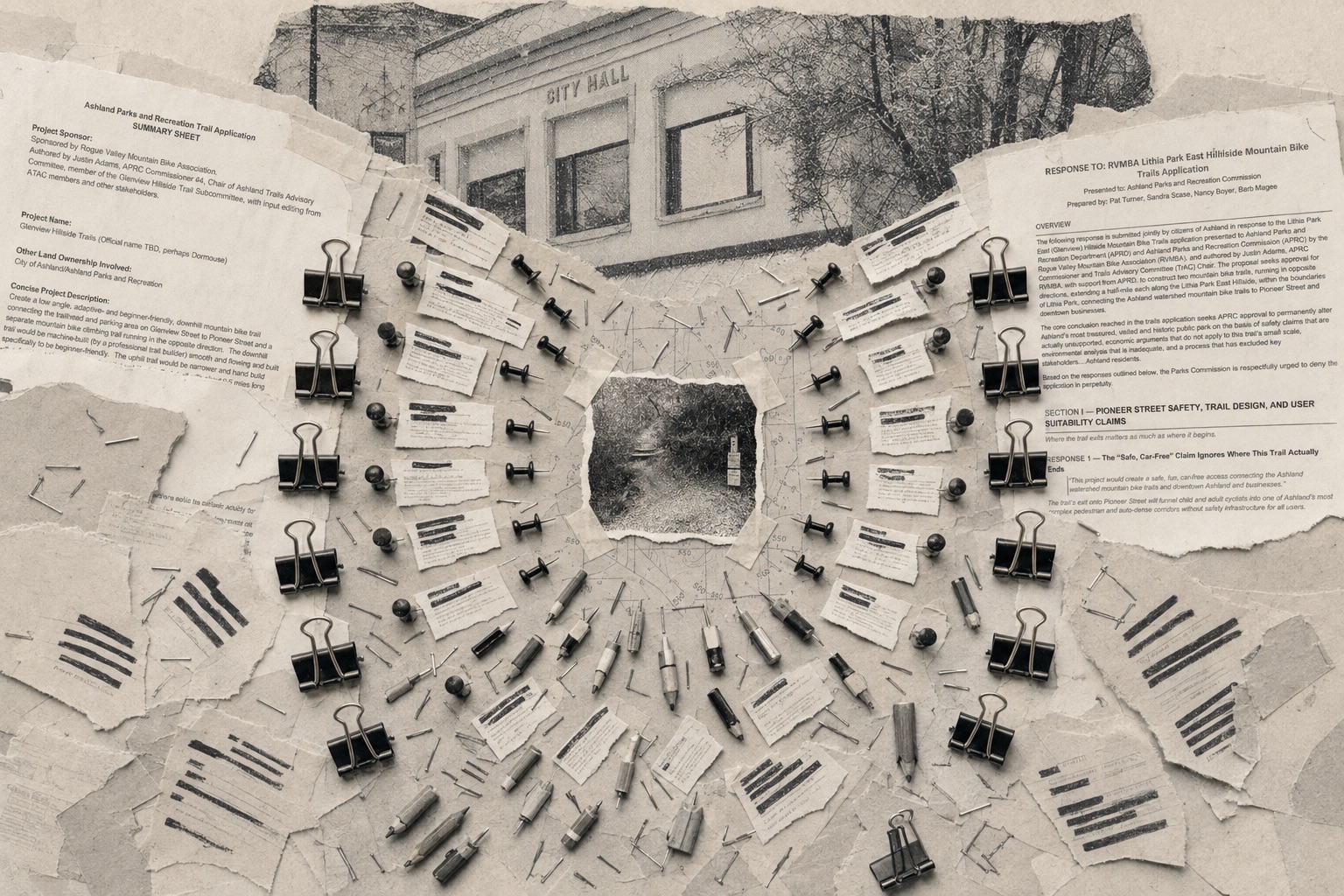
 Art by CONTRA
The Smallest War Ends Two To Three
September 15, 2026 · by Nixie Worthington
Chair Jim Bachman brought up the second business item at the Wednesday meeting of the Ashland Parks and Recreation Commission on the ninth of September by warning the people in the back of the room, who he could see were strategizing, that there would be one minute apiece at the microphone and that anyone who had prepared three minutes should think of it as a summary. The agenda said “potential action” beside the Lithia Park East Hillside Mountain Bike Trails, and the chair said he was going to call it action unless somebody gave him a reason to delay again. Nobody did. About an hour later Commissioner Rick Landt voted no, Commissioner Andrea Weiner yes, the chair no, Commissioner Justin Adams yes and Commissioner Mike Gardiner no, and two dirt paths of about half a mile each on the hillside between Glenview Drive and Pioneer Street, which this town had been arguing about since the autumn of 2025 and in one form or another for a good deal longer, were dead. This paper spent most of a Sunday in August on how they came to be a war and will not go over that ground again here.
Take Me Up On My Offer
Before any of that there was the public forum, the time the commission sets aside at the top of every business meeting for anybody who wants to talk about something not on the agenda, and one man used it. He had been there about three months earlier to ask about a carousel and wanted to know whether the idea was dead or still alive. The chair told him the commission does not engage in conversation during the forum, that staff would note what he said and he was welcome to contact them, and he took that about as well as a person can. Then he came to his second item. Somebody on the dais had told him three months ago that Abraham Lincoln was up in an attic, and he would like Lincoln brought down and allowed to find a sculptor to put the head back on him, and he would pay the full cost of it himself. He gave his references. He had been an airport commissioner, and there is a mural on the side of the airport building that he had seen through, the first artist having wanted four thousand dollars and the local artist he found, Linda Dixon, having done it for eight hundred, which the commission paid, although he would have paid it himself if they had not. The chair thanked him. He said that he would turn ninety-six next week and might not be around much longer, so they should take him up on his offer. The chair congratulated him and said staff would hopefully have a conversation with him in the near future, and moved on to the consent agenda, on which there was nothing, and then to the parks fee, which is another story and will get its own.
The rule the chair cited is a real one and a sound one, since a forum that turned into a negotiation would run all night, and nobody should hold it against him that he applied it. What a reader may hold against the city is the three months. A man came to this commission in the early summer with a question, was told that a statue of the sixteenth president was in an attic, and came back in September with a sculptor’s job priced at nothing to the taxpayer and a record of having got a public mural painted for a fifth of the first quote, and the whole of his government’s answer, across a quarter of a year, was that staff had noted it and would hopefully be in touch. Within the minute the deputy city manager was at the same microphone explaining that the general fund departments have to find roughly two million dollars a year in cuts, more if the parks fee on every utility bill is allowed to lapse, that seven positions are gone already and the seasonal staff thinned, and that the commission would be deciding before long where inside its own department the knife goes. This is a government that has spent the biennium telling its residents there is no money, and when a resident arrives with money and a specific thing to spend it on, the machinery has no slot to put it in. Nobody on the dais was rude to him. They were kind, in the way a bank is kind. The forum exists so that the public can be heard, and it has been refined over the years until being heard is all that happens there, so that a proposal which costs nothing, offends nobody and arrives with its own funding gets the same treatment as a complaint about the restroom hours, which is thanks and a note. I for one hope the department has his telephone number, and that somebody dials it before next week.
I’m Gonna Call It Action
Interim Director Rachel Dials gave the commission the history first, in the order it happened, and it is worth having in one place because most of the argument was conducted without it. The Rogue Valley Mountain Bike Association submitted the proposal to the Trails Advisory Committee on September 17, 2025. That committee recommended it on November 19 to the Forest Lands Management Advisory Committee, which took it up on May 12 and sent its memo on June 4. The commission opened public comment on June 15, took an update on July 8, posted signs at every entrance, exit and trail crossing on the hillside on July 22, gave the whole of its August 5 study session to in-person testimony, closed comment on September 3 and released the staff memorandum, recommending denial, on September 4.
The memo gives six reasons. The Lithia Park Master Plan, adopted by this commission in October 2024 as a hundred-year framework with thirty-seven recommendations, which staff read as steering any bicycle investment to land acquired beside the park rather than to the park itself. The municipal code, section 10.68.210, which the city’s legal department reads as prohibiting bicycles in any park except where the commission has specifically designated a place for them, as it has the skate park and certain watershed trails, so that approving these trails and designating them would satisfy the ordinance without amending it. Enforcement, which the memo calls “nearly impossible” under present budget and staffing, riders straying off designated paths being “a recurring issue already in the Ashland watershed” and e-bikes harder still. Drainage and erosion, on which the department writes that it “lacks internal expertise to assess drainage and erosion on the hillside” and asks that a geotechnical engineer review the whole slope before any final decision, at a cost of eight to ten thousand dollars from the operating budget, with particular worry about the ground near Glenview Drive and Pioneer Street and the possibility of retaining walls. The downhill exit onto the dirt portion of Pioneer Street, a shared-use road, for which the proposal “does not include plans for slowing bikers.” And alternatives, of which the memo says there are viable ones in and around the watershed, and names the pump track and bike skills park now under construction at East Main Street Community Park, due to open in late summer 2027.
On money the memo is brief. The association says about thirty thousand dollars, based on the Wasabi trail as a comparable, and there is money in the parks capital budget for trail work. Other than the geotechnical assessment, “staff does not have an estimate on construction costs to build the proposed trails.” Weiner asked later what would happen if the motion passed, and Dials said staff would work with the association on a construction plan, lay the trail out on the hillside, and “really figure out how much it’s actually gonna cost, because the proposal says $30,000, I’m not sure of that.”
The packet offered the commission two motions, both of them versions of adopting the staff recommendation, with or without amendments. Neither was made.
A More Formidable Barrier To Grass Fires
The document that reached the commission before the staff memo did is on Ashland Fire & Rescue letterhead, from Forestry Officer Chris Chambers, and neither camp has quoted it much, which is probably because it does not do either of them any good. It is not a denial.
“Overall, the proposal can avoid direct impacts to soils and plants if planned, implemented, and monitored carefully. Having a well-used trail (mostly the downhill route) stands to have a positive impact on fire danger by increasing the number of people who can report illegal activities as well as the trail itself being a more formidable barrier to grass fires than the smaller existing trails that have not hindered recent fire spread on this hillside due to their narrow nature. The downhill route is located in a useful location for prescribed fire operations aimed at fortifying Glenview Drive.”
Then fourteen conditions. Sign the pedestrian crossings and think about safety on Pioneer Street toward the Shakespeare campus. Decommission the unmapped trails the route crosses and aim for no net gain in trail mileage on the hillside. Put steps at the mapped crossings so a walker can tell they are entering one. Keep off the mapped milkweed and California lomatium and the rare silk tassel, which is easily confused with mountain mahogany, of which the hillside has plenty. Follow the tree protection code, a machine-built trail disturbing root zones in a way a hand-dug one does not. Pre-treat for invasives, seed the bare dirt with natives, take out the dead and dying trees, and skip the wood cribbing so a prescribed burn does not eat it. Warn riders that closures for fire management take precedence. Consult the forestry officer during layout. Acknowledge that steady bike and human traffic has an effect on wildlife, while noting that the site is already inside the urban core and probably has less wildlife use than most. Write down who maintains it and when, with storm and fire triggers. And consider a State Historic Preservation Office review for cultural and archaeological resources, “given longstanding human use and occupation of sites in the core area of Ashland.”
Nancy Boyer raised that last one from the public microphone, having heard the historic preservation committee take an interest in the hillside, and observed that the people named in the land acknowledgment the commission reads at the top of each meeting “just did not live on the plaza. They lived in the canyon.”
Nancy Created A Spreadsheet
The comment period produced 933 comments from 804 individuals, of which 256 were supportive, 545 were not and three were neutral, or as Dials put it from the dais, “a 32 percent to 68 percent.” Adams asked whether the tally counted a person who wrote five times as five, and it did not, a staff member having built a spreadsheet and taken out the duplicates. The chair named her, and it is the second time in this fight that Nancy Mero has done the tedious part and been thanked for it by name.
Two other versions of the number were spoken that evening. Adams said “803 people.” Landt said, twice, “245 comments supporting a beginner bike trail.” The memo says 804 and 256, and the two commissioners may have been counting different things, support for a beginner trail somewhere as against support for this one here. The gap is smaller than the margin either way, and it is put down here only because a fight that spent two years disputing whose numbers were real finished with three readings of the one number everybody had agreed to collect.
The themes staff drew from the letters are in the packet in no particular order, which Dials confirmed when the chair asked. For: beginner and adaptive access, a safer way down from the watershed trails than Winburn Way, fire mitigation, discouragement of illegal camping, the economy, families with young children. Against: erosion, the loss of quiet, conflict between riders, walkers and wildlife, no need for it, the cost of building and keeping it, riders straying and cutting new trails, the exit onto Pioneer, and bikes through the Shakespeare campus.
The letters themselves are not in the packet. The 191 pages attach the proposal, the trails committee minutes, the fire department memo, the master plan and the ordinance, and not one of the 933. The memo says every comment “has been shared with the Park Commissioners.” This paper drafted a public records request for them in August and has decided against filing it. The decision is made, the letters would arrive weeks after the vote they were written to influence, and eight hundred people who wrote to their parks department in good faith should not learn from a newspaper that their names were the cost of a follow-up.
One Minute For Each Person
Weiner asked, before testimony, whether erosion studies had been done or required on the other trails built in the park and the watershed, “and if not there, why here?” Dials said on some in the past, but that this hillside had its own concerns, and that anyone who stands on Glenview and looks down can see the road sloughing into the slope. Adams asked whether staff had looked at what the Forest Service or the international mountain bike association require before a hillside trail gets that kind of review, and Dials said she had not. He said he was not certain that a road sloughing off was erosion “in the geological sense,” asked whether any geologist or geotechnical engineer had written in against the proposal, which nobody could recall, and said there had been a geologist on the trails committee who thought the trail would protect the slope rather than harm it. The record does not give that geologist a name. Landt confirmed with Dials that the department still wanted the geotechnical study before any final approval, and it did.
Then sixteen people, called up five at a time to stand along the wall, at a minute each. Michael Neiman walks the paths every day and could not imagine heavy machinery carving a four-foot trail without an erosion problem. Barb McGee, a former nurse, said her worry began at the Glenview quarry, where kids coming off the uphill trail would meet southbound traffic on Glenview Street, and ended on the downhill of Pioneer, and that she did not support any testing or assessment “because the risk remains the same whether you do an assessment or not.” Kurt Evans said the mountain bike community had been bombarded with unfounded fears. Monika Settles had driven her son thirty to sixty minutes to Lake of the Woods to find a trail a beginner could ride and said it was a shame she had to put him in a car to get somewhere safe to learn. Jan Calvin, one of the three neutrals, and “not without passion,” said the process had sidestepped or disregarded the procedures the commission already had, had eliminated its own objective criteria, had abandoned the capital improvement process and had set the community up for a battle, and that “there is no enemy here.” A boy named Luke spoke for the trail. Wiley Chase came from Medford. Pat Turner said the debate had been emotional, spirited and sometimes downright nasty, that the community was divided and that the process reflected badly on the commission, and then tied it to the parks fee and the beverage tax, which expires in 2030. Ed Zobel, thirty-eight years beside the park, had heard that the paths were well engineered, with excellent visibility where they crossed, and said that was like saying you could dodge the bikes efficiently: “Why do we have to dodge the bikes?” Jim Bowen, twenty-six years in town, counted six to eight crossings, said an e-bike cannot be stopped, and asked the commission to follow its staff, not to waste money on erosion control, and to “leave us the hikers this one thing.”
Boyer, besides the canyon, asked Adams to correct a figure she said he had been using, forty to fifty-three bicycle accidents on Winburn Way, when the ad hoc committees had corrected their own minutes to say one in ten years. Adams in his remarks later gave it as an average of more than four reported motor vehicle versus bicycle accidents a year over the last decade between the bandshell and the plaza. Both numbers went into the record and the record does not settle them, and the city’s crash log would.
The other side of the room was younger. Audrey Taylor spoke, and Natalie, who said her age is six and mountain biking is really fun and this is her first year, and Callum Taylor, who arrived from soccer practice in the middle of the item and was told just in time, you’re up, we have one minute here. A mother whose name the captions garble held her son Otto, who is nearly three, and said that most of the children in the room had been his age when this project started, and that she would like him on a beginner trail before he is twelve and past needing one. Merlin Stewart, who coaches and is board president of Ashland Devo, told the commission the city will never have unlimited money for education, maintenance or enforcement, but that it has organized groups of trail users willing to take responsibility for the places they ride, and asked it to see them as a resource rather than a burden.
The Chair Will Entertain A Motion
Adams made it. “I move that we approve the Dormouse, a.k.a. East Lithia Hillside mountain bike trail, and that we ask the park staff to return with best practice guidelines from the Forest Service and/or [IMBA] regarding the need for a geotechnical assessment.” The motion, in other words, was to approve the trails and to send staff looking for an authority that would say the study they had asked for was unnecessary.
The captions do not settle who seconded it. The chair says “I’ll second to ensure we have some discussion and conversation,” and a few minutes later invites Commissioner Weiner to speak to her second, and the minutes, when they are approved some weeks from now, will say which of them it was.
This paper reported on August 30 that Commissioner Adams wrote the application, which says so on its own summary sheet, that he sits as the commission’s non-voting member on the Trails Advisory Committee that recommended it in November, and that a former councilor on that committee filed a complaint over the November vote under Oregon’s public meetings law. The fire department’s memo records that he and Weiner were at the May 12 meeting to answer questions about the proposal. On September 9 he moved it, spoke to it for eleven minutes and voted for it. Neither the September 9 transcript nor the August 5 transcript contains a declaration of conflict, a recusal or a discussion of either, and whether Oregon’s rules for public officials reach a volunteer trail application written for a club is a question this paper has not answered and will not answer in a sentence. What can be said is that in two years nobody in the room, on either side, put the question, and the two sides in this fight have put very nearly every other question there is.
There Is No Magical Barrier
Adams framed his eleven minutes as a series of messages the commission would be sending with each vote, and the demography of the letters as he read them, the yes side mostly though not exclusively younger, children and their parents and young professionals, the no side mostly though not exclusively older people who had moved to Ashland to retire or had finished their careers here and liked to walk, sometimes with dogs. He offered the one argument on his side that the other side has never answered: “There is no magical barrier surrounding Lithia Park that keeps mountain bikers out. And let’s face it, there isn’t much enforcement. The only thing that keeps all but a handful of the hundreds of cyclists who enjoy Ashland’s trails daily out of Lithia Park is their choice not to ride there.” A dedicated trail, he said, keeps riders off a pedestrian path better than anything else does, and the proposal commits in writing to decommissioning the unsanctioned trails already on that slope. He also spent a passage on pickleball, and on the oldest continuously used tennis courts in Oregon having been given over to it under pressure from the same seniors who invoke John McLaren like a founding father, McLaren having designed the park in 1913 and pickleball not having been invented for some decades after, and on residents who write in capitals, deface signs and demean mountain bikers on YouTube. He said the park no longer has a zoo, or free car camping on the creek, and that Lithia Park is not a painting, it is a park, a line he credited to former Commissioner Jim Lewis.
Weiner promised to be about half as long and announced that her remarks would “in no way, shape or form support pickleball in Lithia Park,” which got the only laugh of the night. Her three points were that the engagement showed the demand was real, that the concerns could be mitigated with thoughtful design and that a commission which only ever takes up-or-down votes never improves anything, and that the body should be data driven rather than emotion driven, half the letters saying nobody walks those paths and half saying they are heavily used, “but we don’t have any data to demonstrate one way or the other.”
Landt said he would vote no, informed by the master plan and the staff report, that the 245 comments in favor of a beginner trail were meaningful, and that “if this doesn’t pass, I will follow up with a motion to at least in some way address that.” Gardiner said it was not a beauty contest and not the one with the most wins, that he had heard loud and clear what the community cherished, and that the thing that decided him was what Landt had said: “our policy of the Lithia Park master plan, to adopt that and then to ignore it, is a problem for me.”
The chair spoke last and at length, and roughly, which is how he talks.
“I’m gonna vote against this motion. I find my personal core mission for this group is to protect the people’s land in perpetuity. Doesn’t mean there can’t be change, the only constant is change, but to do it in a very deliberate way and to, and provide stewardship for all the open land, open space, trails and parks. That’s a core mission. Now, we’ve added recreation, we’ve added senior services, but the core mission was started out, and I firmly believe, and one of the reasons I’m up here is there’s a constant erosion of support for public lands coming from some political sectors.”
He said mountain biking is without doubt an economic driver in this town, that he agreed there is not enough access from town to the watershed trails for beginners, that Ashland is a big place and Lithia Park a small part of it, and that “the thing that seals the deal for me is it’s a two-to-one public comment that we shouldn’t put this trail in this spot.”
Adams took a minute more to say that the master plan as adopted had been amended to say future trail development in the park should avoid the riparian corridor, so that this trail was entirely consistent with it, and to thank the youth who had ridden in to speak “sweating in their mountain bike helmets.” “Whatever the vote of this body, and it doesn’t look great for us,” he said, “I read your emails. I see you and I feel you.” Then the roll call, and the motion failed two to three.
Patently Ridiculous
Landt moved at once “to reaffirm the Lithia Park Master Plan’s prohibition of new bike trails through Lithia Park and direct the Trails Advisory Committee to work with RVMBA and other groups and individuals to find a site for a beginner’s mountain bike trail outside of Lithia Park.” Speaking to it, he disputed Adams’s reading of the addendum, the addition to the plan having been an addition and not a subtraction, and asked that the committee treat the search as a priority.
Gardiner said he was surprised the yes votes had not wanted to support further investigation. Adams said the first half of the motion was “patently ridiculous” and the second half “completely meaningless,” and that he would vote against it. Weiner said she had been taken a little aback by the first half, had pondered it a wee bit, and had concluded that if the plan said what Adams and her own reading said it did then she could affirm it, that most of the ground outside the park is Forest Service land and “it’ll require aggressive engagement with them,” and that “I just think that it was a bit wonky.” The chair said he was going to support her. Weiner yes, Bachman yes, Adams no, Gardiner yes, Landt yes.
So the commission has directed a committee with the author of the proposal it had just rejected at its table to go and find another site for the same idea, with no site in hand and no money named. That committee meets on Wednesday the sixteenth at four fifteen at The Grove, and the department has already put the item on its agenda.
The Verdict
Three commissioners reached the right answer for the reason a commission is supposed to reach answers, which is that they had adopted a plan two years ago and the plan said no, and Gardiner said so in one sentence where the staff memorandum took six pages.
What will outlast the trail is the other thing. A commissioner wrote an application, was at the table when a committee sent it forward, sat on the dais that judged it, made the motion and cast a vote, and in two years of the most closely watched argument this town has produced, with a complaint already before the state over the committee’s November meeting, nobody on either side asked him to step back for the vote and he did not offer to. The rules may permit every bit of that. Adams has said he will not seek a second term and three of the five seats turn over this cycle, so the next time a commissioner brings the commission a proposal in his own hand, the question should be asked out loud before the roll is called, by the chair if nobody else will.
Natalie, who is six, told five adults that mountain biking is really fun. Callum Taylor came from soccer practice and spoke anyway. Otto, who is nearly three, was held up to the room by his mother, who would like him on a beginner trail before he is twelve, and what the three of them were sent home with is a committee meeting on the sixteenth. As the room emptied somebody the recording never identifies said “disappointed” into a live microphone, and that is the last word the record has.
Correction, Sept. 24, 2026: this piece said, following this paper’s August 30 report, that Commissioner Adams chairs the Trails Advisory Committee. The committee’s minutes list Josh Cott as chair and Adams as the Park Commission’s non-voting ex officio member, and the committee’s November 19 recommendation carried 5–1 without his vote. The application’s summary sheet calls its author the committee’s chair, and that is where the error began. Three passages have been corrected. Nothing else in the account of his role changes: he wrote the application, was present when the committee recommended it, and moved it and voted for it on September 9.
Sources: the caption transcript of the September 9, 2026 business meeting of the Ashland Parks and Recreation Commission and the 191-page packet published for it, whose first fifteen pages are Interim Director Rachel Dials’s memorandum of September 4 and whose attachments include the application’s summary sheet, the November 19 Trails Advisory Committee minutes, the Lithia Park Master Plan, AMC 10.68.210 and Forestry Officer Chris Chambers’s memorandum for the Forest Lands Management Advisory Committee, all quoted here from the documents. The 933 public comments are not in the packet and this paper has chosen not to request them, for the reason given above, so everything said here about what they contain is the department’s summary of them and is labelled as such. The Winburn Way crash figures are two speakers’ figures and not the city’s, and the sentence that gives them says so. Minutes for this meeting will not be approved for some weeks, so both roll calls and every name are taken from the captions and checked against the spelling the city’s own minutes use, and where the two disagree the minutes will win and this paper will print the correction. The captions do not establish who seconded the first motion and this piece does not guess. Commissioner Adams’s authorship of the application is stated on the application’s own summary sheet, and the absence of a conflict declaration is an absence in the transcripts of September 9 and August 5, not a finding about what he was obliged to declare. The man who spoke at the public forum does not give his name anywhere on the recording, and it is not printed here because he came to talk about a statue and not to be in a newspaper. The mother of the boy named Otto is not named because the captions garble her surname and no minutes yet exist to correct it. Quotations appear as transcribed, with the software’s garbles repaired and the speakers’ left alone.