
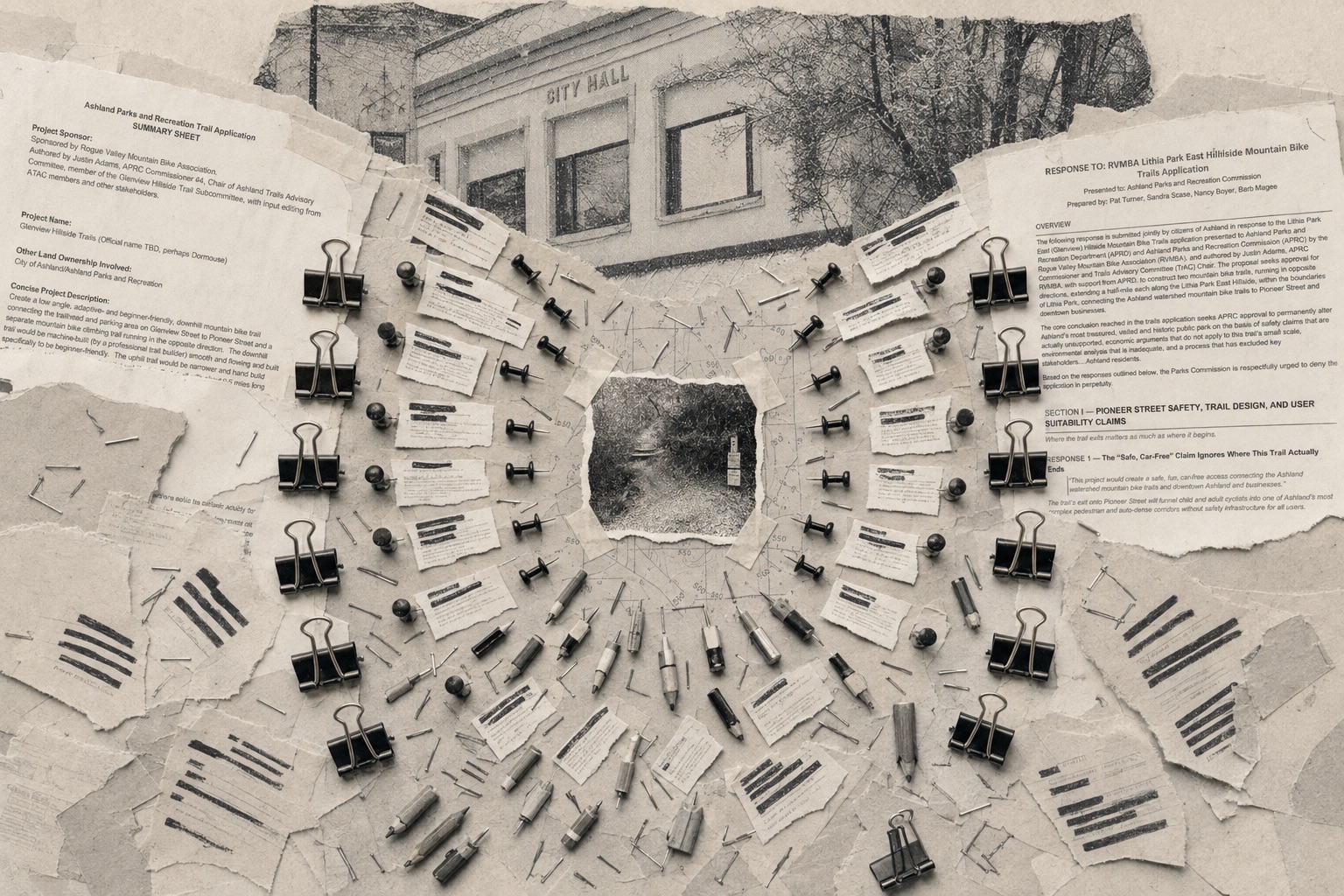
 Art by CONTRA
The Smallest War in Oregon
August 30, 2026 · by Nixie Worthington
Somewhere in America this month, a parks board approved a mile of mountain bike trail in about eleven minutes, between the pickleball resurfacing item and the restroom winterization item, and the local paper gave it a paragraph. We conjecture, but confidently: it happens all the time, in Bend and Bentonville and a hundred towns nobody writes about, because in most of America a mile of singletrack costing $30,000 is what a parks agenda calls Tuesday.
In Ashland it is a war.
It has a two-year history, a procedural complaint before a state ethics body, a fifty-page legal memo, dueling advisory committees, a campaign website, a counter-campaign website, a 23-point rebuttal document, guest opinions in three publications, at least one letter citing John McLaren from beyond the grave, 390 public comments — the most the parks department’s institutional memory can produce for any issue in about 23 years — and, on the fifth of August, a room so far past fire-code capacity that the chair had to ban applause and teach a standing crowd the jazz-hands sign for approval, having first gaveled them into what he optimistically called order.
All of this over two dirt paths, each roughly half a mile long, on a brush-covered slope most residents could not point to on a map of their own park.
A town gets here on purpose, by a long series of small choices, and the bicycles are the least of them. The war is now arriving at its constitutional moment, and the vote is set for September 9, and somewhere along the way the question on the table changed from should the trail exist to who gets to decide, and when, and whether waiting is wisdom or surrender. Follow the half mile and it will take you the whole way around this town.
What Thirty Thousand Dollars Buys, Allegedly
The facts first, briefly, there are not many of them.
The Rogue Valley Mountain Bike Association proposes two one-way, bicycle-only trails on Lithia Park’s East Hillside, between Glenview Drive at the top and the car-free gravel stretch of South Pioneer Street at the bottom: a machine-built descent, working name Dormouse, and a hand-built climb. About $30,000, by the applicant’s own estimate, which rests on Wasabi as the comparable and on no bid, since the contractor is to be chosen by RFP after approval. The money would be the $75,000 the Parks capital plan already holds for trail work on White Rabbit in Siskiyou Mountain Park, which the advisory committee would rather spend here and which only the Commission can redirect. Maintenance by volunteers, per the City’s own application form, which assigns upkeep to whoever proposes a trail. The pitch: the first true beginner trail near town, a car-free way down from the watershed network, and a sanctioned line on a slope where bikes already ride illegally on footpaths that, per the application’s own words, “were never designed and instead were adopted and modified after being created by unsanctioned use.”
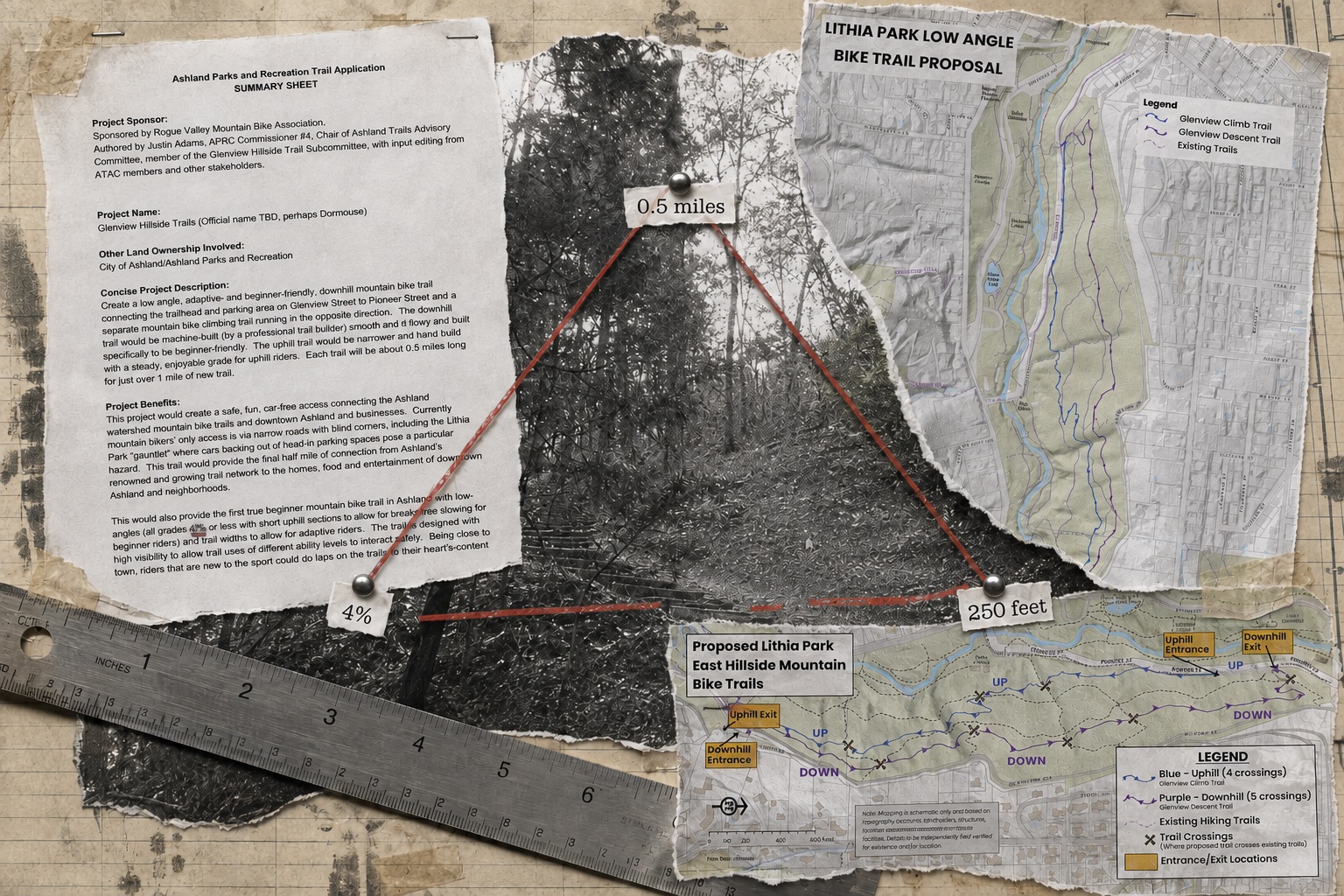
Small, checkable details, the kind that decide whether a thing can actually be built, get trodden down early and by both sides, not because anyone disputes them but because nobody has a use for them.
Each camp has sorted every fact by which side it helps, and a fact that merely indicts the paperwork belongs to no one.
Two Years of History in One Sitting
The war predates the trail. The 2024 Lithia Park Master Plan process — the “hundred-year plan” — carried an earlier version of the idea, and the fight then was about the terminus: end at Pioneer Street, or run gloriously on past the duck pond to the Plaza itself — a Champs-Élysées for the fat-tire set, beloved of some riders and touched by no committee. The terminus has been the casus belli from the beginning. By September 2024 the Chronicle reported the final draft contained no bike trails at all. The adopted plan steered mountain-bike investment toward land adjacent to the park, while an addendum left a door ajar for future consideration inside it, away from the creek. The two camps have been quoting their preferred half of that document ever since, up to and including two commissioners and a staff slide detonating one another in public on August 5, twenty-two months after adoption.
September 17, 2025: a fresh application for the shorter alignment, sponsored by RVMBA and written, sole-authored, per a newspaper correction that mattered, by Parks Commissioner Justin Adams, who also sits on the Trails Advisory Committee as the Park Commission’s non-voting member. On November 19, with the author at the table, that committee voted to recommend the author’s proposal, at a meeting where the item had been noticed on the agenda as informational. A committee member, Stefani Seffinger, a former city councilor, filed a complaint arguing the vote violated Oregon public meetings law. The City Attorney answered in roughly fifty pages that an advisory body may recommend things. Fifty pages, and the application is fourteen. The matter went to the state ethics commission, where its outcome has never surfaced in the public record. Parks staff, for what it is worth, had recommended holding a public meeting and comment period before any committee recommendation, but that is not what happened.
Then the summer of small erosions: comment opened June 15, a promised guided public walk of the route became, in the space of a month, “a potential onsite meeting,” and then nothing, flagging of the route began on the ground weeks before the announced marking window opened, a City forestry review returned fifteen recommendations that residents cannot find posted anywhere, and the City’s own project map changed its crossing count without a revision note, the sign on the hillside still carrying the old number under the same print date. None of it is a scandal, and this paper alleges none. All of it is the same choice made over and over by the same body: that telling people things is a step which can be taken later, or somewhere else, or not at all. A public that watches a process wobble like this does not become suspicious of trails. It becomes suspicious of everything, and then a study session needs a fire marshal.
And then August 5. Twenty-two months after the master plan was adopted, eleven months after the application was filed, seven weeks into a public comment period, in a room the fire marshal was counting, staff told the Commission and the town that bicycles are banned from Lithia Park by municipal code, and that a yes vote here still requires the City Council to change the law before anyone may legally ride a foot of what they were arguing about.

Every resident who filed one of the first several hundred comments, every speaker who spent two minutes at that podium, every household that had this argument over dinner, was arguing about a bicycle trail in a park where bicycles are illegal, and about a decision the Parks Commission cannot make by itself. It is the single most important fact about the proposal, it was true on the first day and every day after, and the public learned it in the twenty-third month, in passing, because a study session got around to it.
The public learned that bicycles are illegal in Lithia Park in the twenty-third month of the argument about a bicycle trail in Lithia Park.
The Order of Battle
The association. RVMBA is the valley’s mountain-bike organization, the IMBA-affiliated club whose volunteers built and maintain much of the trail network in the hills above town, a network the club’s own materials count generously and the careful count puts at about 53 miles in the Ashland watershed. That number matters, because it is both sides’ favorite weapon: the opposition asks why a club with 53 miles needs one more in the park’s last quiet corner, and the club answers that not one of those 53 is rideable by a beginner or a child, the watershed is steep, and Wasabi, the trail built a decade ago with beginner hopes, came out with banked switchbacks and an intermediate climb, a failure the current application admits with unusual candor.
The author. Commissioner Adams wrote the proposal, sits on the committee that recommended it, carried its statistics through nine prepared minutes on August 5, and announced on August 11 that he will not seek a second term, citing family, work, and health. Under the application’s own construction plan that committee’s chair would review the bids and pick the contractor, and its members would walk the finished trail for final approval, with staff, and the Commission would not. His conflict is not financial. It is personal, the mountain biker’s origin story, his own son nearly struck on Winburn Way. He has acknowledged the optics sideways: “more than 90% of my time is spent working on topics… that do not involve mountain biking”, which, as we observed at the time, is the kind of statistic one volunteers only when the other ten percent is standing at the podium.
The opposition. Not one thing but a coalition: the Behind the Curtain campaign site, which has made the trail a chapter in its broader case against city government, the authors of a 23-point technical rebuttal, whose best points — an adaptive-standard claim the application cannot back, an accident statistic that collapses under a filtered query — are good ones, and earned, a respected ecologist’s viewpoint arguing this slope is the city’s last intact pine-oak woodland, the former councilor pressing the process complaint, and behind them a broad, real constituency of walkers and dog owners for whom the flat gravel stretch of Pioneer is the one dirt route in town that asks nothing of the knees, but their strongest material is strong. Their weakest, we will get to it, is doing their cause active harm.
The supporters. The club, the bike shop owner who testifies he has no answer to “where do you take kids?”, the Devo youth-cycling coach who named the gap exactly (“If you’re an experienced rider, Ashland is world class. But if you’re a child… there isn’t an entry point”), the twelve-year-old who filed the shortest brief in the record (“I would totally ride this trail”), and — awkwardly for the tidy version of this story — the trail-running author of the most rigorous critique of the application, who wants it built anyway, with seventeen conditions. The support is younger, less organized, less practiced at public comment, and largely absent from letters pages, which has allowed the impression that it barely exists, and three hundred ninety comments say otherwise.
The Fight Under the Fight
Spend enough hours with the transcripts, this paper has now spent more of them than anyone should admit to in print, and the pattern stops being about dirt.
It is about age, first, though nobody wants to say it plainly. A speaker told the Commission that over seventy percent of Ashland is over 55, the census puts the over-60 share nearer a third, and instructed the commissioners: “your special interest, you want your bike stuff.” The room’s most reliable applause lines (jazz hands, by then) tracked the demographic split almost perfectly: the walkers who have loved this hillside for forty years against the parents whose children have nowhere legal to ride, each side sincerely unable to see itself as the special interest. Sage Connolly, a mountain biker, took his two minutes to read out five satirical reasons to oppose the trail — anything outdoors is unsafe, children should stay indoors, “biking in our park. What’s next? Girls on bikes in our park” — and drew a gasp before the room caught the joke, which rather proved the joke.
It is about class-of-resident, second: who counts as Ashland. The opposition speaks of visitors and outsiders and Devo families from elsewhere. The supporters note that the median opponent has time to attend a 5:30 study session on a Tuesday. Each side accuses the other of astroturf, of being a small group impersonating a large one, and, in the comment threads this paper has read in quantity and will characterize only in aggregate, they do it in nearly identical language, each certain the other’s letters are coordinated and its own are spontaneous.
And it is about the city itself. This is Ashland in the third year of its civic confidence crisis — the parks-fee fight, the City Hall fight, the everything fight — and the trail has become the small, walkable proxy for the large, abstract question of whether anything this government touches can be trusted.
When the shared record is unreliable — when the numbers in the application cannot all be true, the map revises itself without saying so, the review is unpublished and the governing plan can be quoted both ways — then nobody can argue from the record, because there is no record both sides will stand on. So they argue from the only things left: motive, identity, and who counts as a real resident. That is not a failure of neighborliness. It is what people do when the paperwork will not hold weight.
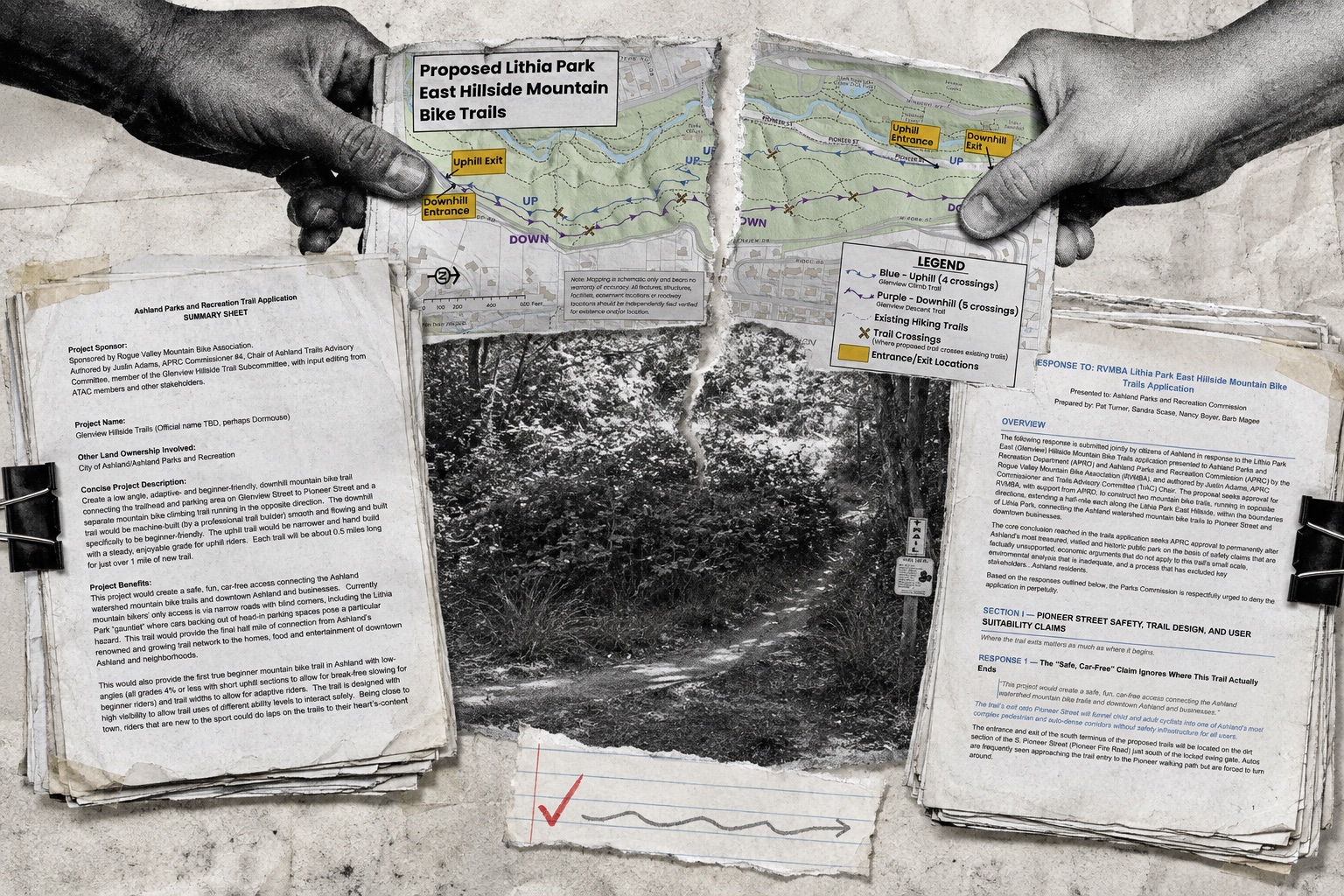
And it is fatal to the middle, because the middle is the only position that needs the record to exist. The one conditional voice in this fight — supports the trail, seventeen conditions, keeps a public corrections log — did not lose an argument. His list was renamed “a bait-and-switch” by “a select group of mountain bikers,” and he was reclassified as the enemy, which is cheaper than answering him. Meanwhile the single most damning fact anyone has produced, that the application’s own three central figures cannot all be true at once, sits where it has sat since June: adopted by neither camp, because it indicts the paperwork and the paperwork is not on the ballot. A town with a trustworthy record would have started there. This one has nowhere to put it.
The one fact that indicts only the paperwork belongs to nobody, because the paperwork is not on the ballot.
The hand-wringing has earned more than a paragraph, and the record supplies it in the opposition’s own words.
At the podium on August 5: the trail “will destroy the peace and tranquility of the park.” It “will destroy the native and cultured plants… and will adversely affect the wildlife.” “You’re gonna take a mini excavator in there, you’re gonna destroy the plants.” The hillside, per two separate speakers, is “sacred.” This for a proposal whose own City forestry review, fifteen recommendations attached, found the impacts avoidable with careful planning, and whose subject is a slope the park’s visitors overwhelmingly never set foot on. Destroy, three times, for half a mile of hand-raked tread. That register did not come out of any stewardship manual, but it came out of church.
The campaign apparatus matches the register. The Behind the Curtain page instructs its readers to email the Parks Commission with the subject line “NO Bike Trails in Lithia Park!”, capitals and exclamation point supplied, and closes its case with “Just say No. Not maybe.” Its treatment of the one conditional voice in the debate is to call a published list of conditions “a bait-and-switch” and “a roadmap to approval,” authored by “a select group of mountain bikers”, the select group being, as far as this paper can establish, one trail runner with a corrections log. When your campaign’s strongest engagement with the most careful document in the fight is to rename its author, the campaign is telling you what it can and cannot answer.
And then there is the comedy, which this paper has thought about longer than it expected to.
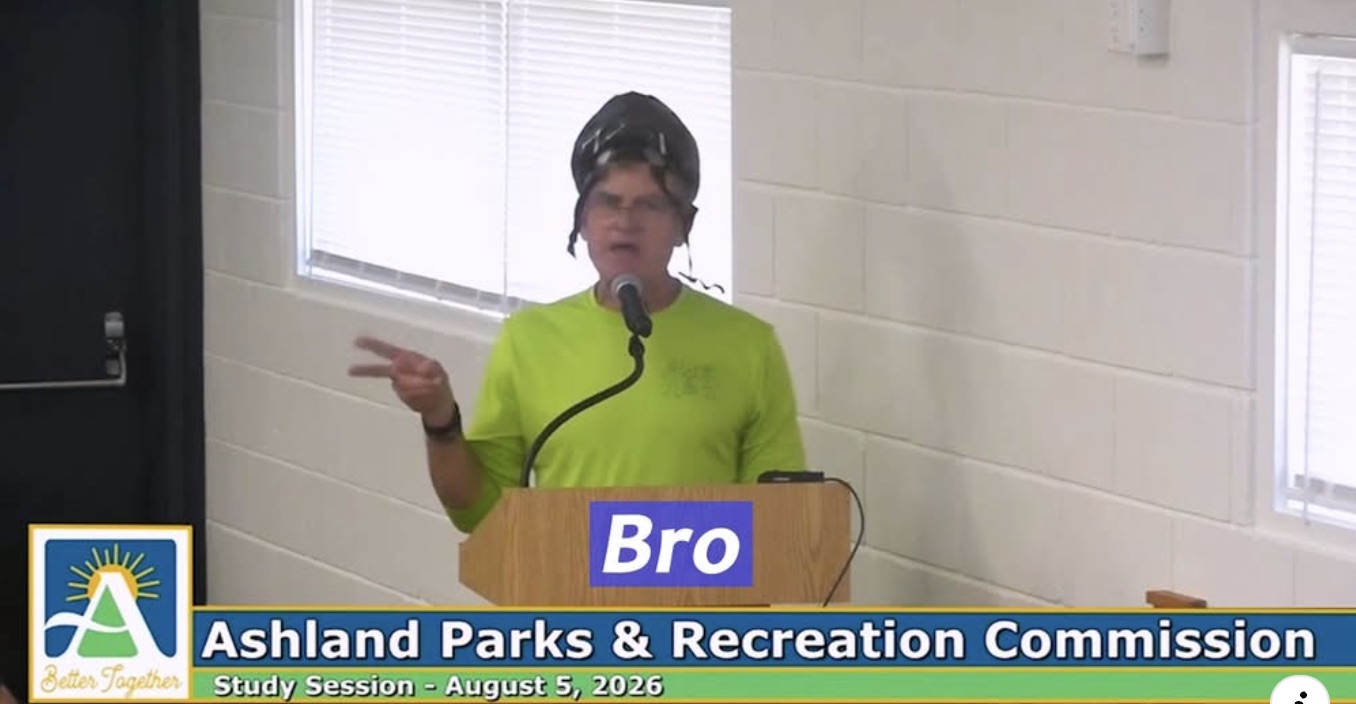
Connolly’s bit included a line about the city pandering to “those who post most on Facebook and make YouTube videos.” Three speakers later, one of them took the podium. Jim Falkenstein, as Bro Falkenstein, a character he also performs on YouTube, spent his two minutes as a wealthy mountain biker: “Fellow bros of the Manosphere and Lady Bros. We totally deserve these two new mountain bike trails.” He owns five mountain bikes, “but only three of them cost me over 10 grand each.” Asked to justify the trails, the character recites the reasons he has “been told to say — for the kids and fire migration and economics”, before admitting it is “just for me to have one half mile more of epic mountain bike shredding.” It closes with the bros telling “the Karens and the complainers and the locals and the old timers and the grannies to suck it.” The chair cut him off: Excuse me, you’re done.
It is skilled work, and the video version is better than the podium version, because after the character runs out the bit turns into two minutes of the clearest public explanation of this geography anyone has produced: Glenview is chip-sealed, the main park trail is bark chip and nobody wants to ride it, Pioneer is already shared and that is not changing. He also says the thing the whole fight is short of: “I wasn’t on the committee, I don’t know if this is real, it’s kind of a guesstimate”, and then he walked it and checked. A man with that much command of the map spent his two public minutes doing a voice.
This desk is not the room’s decorum monitor, and satire aimed at power is older than the republic. But the power in that room was seated at the front, and the bit’s targets were the people in the folding chairs: the families, the coach, the twelve-year-old. Punching at a dais is comedy. Reading a room full of your neighbors their own supposed contempt for grannies, while they wait their turn to speak, is something else, and the laugh it got does not settle which.
What happened afterward settles more. When a member of the bike community wrote that his side had worked through the system for a year and got a prop comic for its trouble, the replies informed him he was a “bike bro” with thin skin, weeping emoji supplied. Councilor Dylan Bloom, who may yet vote on the ordinance this requires, called it one of the best uses of satire he had seen at a public forum and praised it as “making fun of local government”, which it conspicuously was not.
Local government was the audience. The neighbors were the joke.
For the avoidance of doubt: this paper has defended Jim Falkenstein in print, over a police officer sent to his driveway after he reported an unlocked public building, and would do it again tomorrow. That is precisely why this is worth saying. He is not a troll. He is one of the more capable civic minds in this argument, which is the whole subject of this piece, and he aimed it at the grannies.
And the columns. The Chronicle’s opinion page has lately taken up the genre this paper can only call anticipatory grief: pieces devoted to toppling the minor arguments of the other side, one aimed at the notion that trails get kids off screens. Another, this week, methodically dismantling an economic case nobody with a name attached ever made at that scale, under a headline answering a question no one asked. No, mountain bikers should not be the arbiters of Ashland’s economic survival. They were not applying for the position. The sponsor’s own strongest advocate wrote that “the goal isn’t to make Lithia Park a mountain bike park.” When a movement starts winning arguments nobody is making, it is usually because the arguments people are making — where do children ride, what happens to the paperwork’s numbers, who maintains this in year ten — have gotten uncomfortable.
The supporters are not innocent of the mirror-image sin: answering specific, checkable objections about width standards and crossing counts with the general goodness of childhood exercise. A town can produce ten thousand words a week about a hillside and somehow leave each camp dodging the other’s best case. Ashland has managed it all summer.
September 9: Good, Bad, and Ugly
So: the vote. The Commission has set “potential action” for its September 9 business meeting — potential action being bureaucrat for a vote, unless the room looks dangerous. Comments close September 3, and the newest front in the war — opened the moment Adams announced his departure — is whether voting at all is legitimate. Three of the five commission seats turn over this cycle. Exactly three candidates filed for them. The question now circulating, in public comment and in the threads, is whether a lame-duck commission, including the proposal’s own author, should decide a contested question it will not be present to manage. And each camp has discovered, with the flexibility that is this war’s most renewable resource, exactly the principled position that happens to serve it.
One fact ought to cool all of this, which is presumably why neither camp has raised it: because the ordinance has to change, the Council gets the last word regardless. A departing commission cannot push anything through to completion. It can hand a recommendation to a body with four seats on the November ballot, and that is the whole of its power here. The legitimacy war is being fought over a decision that is not final in either direction, a fact the Commission has been in a position to say out loud since August 5, and has not.
The case that postponement is good is the boring one, and this paper laid most of it out above: the application’s numbers need correcting, the adaptive claim needs a standard or a retraction, the forestry review needs publishing, the ordinance step — because, as staff finally told the room on August 5, bicycles are banned from the park by municipal code and a yes here still requires the City Council to change it — needs a stated timeline. A postponement that produces corrected paperwork defeats nobody.
The case that postponement is bad has teeth of its own. This proposal has been in some version of process since 2024. Every month of delay is another month in which the actual current condition, illegal riding on undesigned footpaths, the thing both camps claim to hate, continues unmanaged. Comment was open for eleven weeks, the route was flagged on the ground, a record 390 people weighed in. At some point “more process” stops being diligence and becomes a decision in favor of the status quo that nobody voted for either. The opposition knows this, which is why delay is its second-favorite ask.
And the ugly: the version now unfolding, in which the postponement question itself becomes the war. Supporters read every call to wait as Ashland’s veteran obstruction playbook, the same town that has studied its own buildings for eighteen years without repairing a rafter, now proposing to study a half-mile of dirt into the next decade. Opponents read any September vote as a departing author jamming his legacy project through a friendly board before the electorate can reach it. Both camps are now publicly excoriating not each other’s arguments but each other’s legitimacy, and that is the corrosive development, because arguments end and legitimacy wars do not.
The Verdict, Which Is Not About the Trail
This paper ends up less with a position on bicycles than with one on proportion.
This is, measured against everything else on this town’s docket, a minor question, a mile of dirt. Thirty thousand dollars, roughly one percent of the first phase of the park project across town that draws a fraction of the letters. A slope that carries trespassing bikes today and will carry them, sanctioned or not, in every future anyone votes for. In the great ledger of things Ashland must decide this fall — a city manager, a charter’s worth of habits, four council seats — Dormouse is a footnote with a fan club.
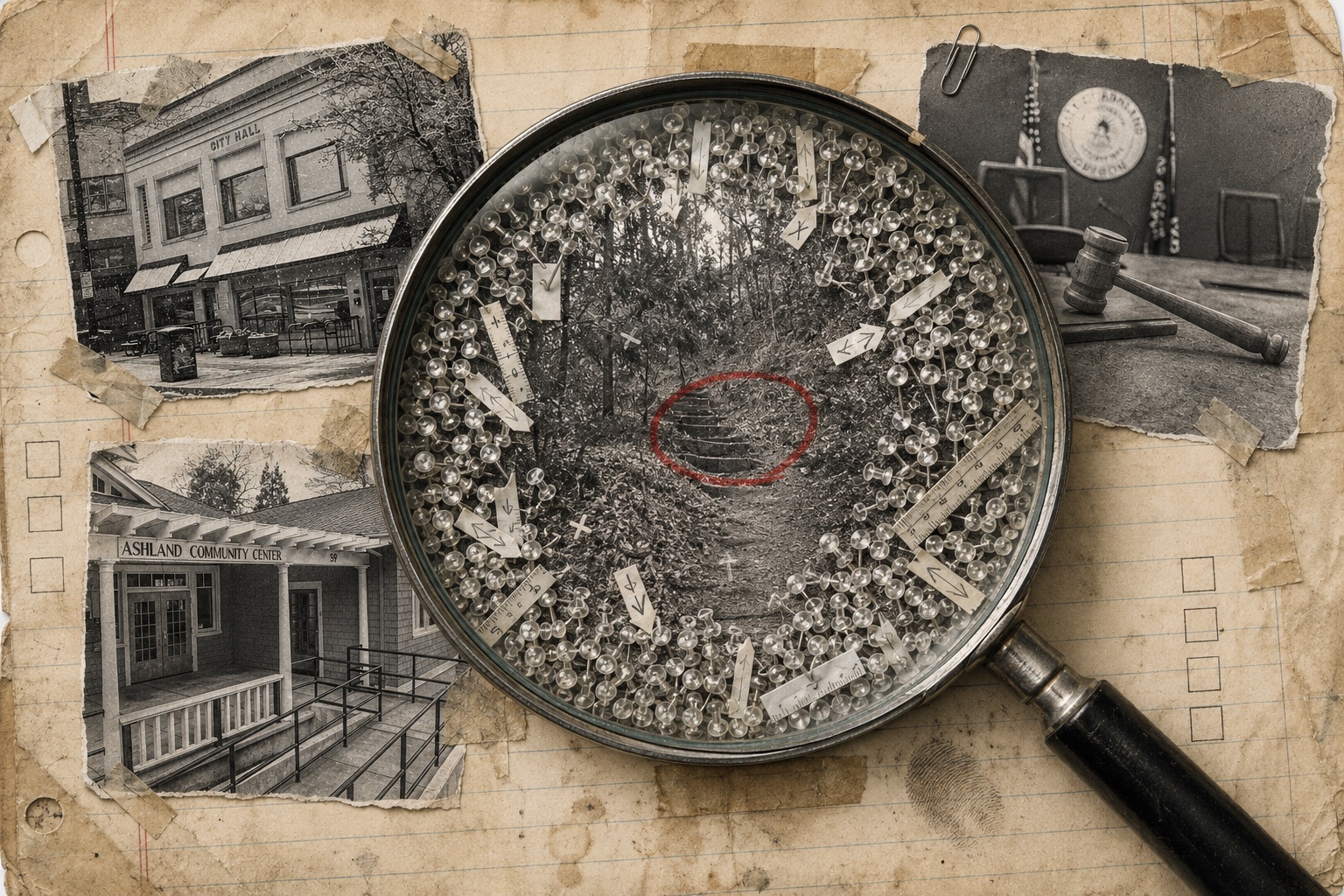
And it has consumed the summer, because it is legible in a way the big things are not. Nobody can hold the structural deficit in their hands. Anyone can stand on the East Hillside, it is your hillside, and the flags are in the ground until September 3. Go stand on it. The smallness is not incidental to the heat. It is the cause of it. This is the faculty fight moved outdoors: vicious because the stakes are low, except here they are not quite zero, which turns the viciousness from a comedy into a waste. Somewhere under the jazz hands there is a real child on a real bike on Winburn Way, a real corridor of birds and rare plants, real seniors on the one flat dirt road in town, and a real volunteer club offering real labor to a city that, on current evidence, cannot maintain what it already owns.
On the vote itself, briefly, because it has stopped being the interesting question: wait, but price the wait. Postpone once, in public, with a list — the corrected figures, the named standard, the published review, the Council timeline, the maintenance agreement in writing, and a construction agreement that says who picks the contractor and who accepts the trail — and a date certain in front of the incoming commission, so the delay cannot quietly become the tenth year of a two-year process. If the proposal cannot survive its own paperwork being corrected, it should die. If it can, three new commissioners will own it honestly, and either outcome is fine, but the trail was never the point.
The point goes, by name, to everyone this piece has described, and it comes with something close to admiration, which is what makes it hurt.
This fight has been a full inventory of what this town is capable of when it cares. The Rogue Valley Mountain Bike Association can organize volunteers, draft a fourteen-page application, produce a video, and offer a city free labor in perpetuity. The authors of the 23-point rebuttal performed better technical review of a $30,000 proposal, caught a false statistic, ran down a published engineering standard, than anyone performed on the compensation schedule that cost this town two million dollars. And then the author of easthillsidetrails.org: one resident, one half-mile trail proposal, and a corrections log in which he retracts his own findings, with dates, when the math improves. He holds a dirt path to a standard of self-correction that nothing the government of Ashland publishes has ever met, and the tragedy on this hillside is that he aimed it at the hillside. The Behind the Curtain operation, meanwhile, has demonstrated it can mine municipal records with the patience of a forensic accountant, and three hundred ninety residents wrote comments. A room overflowed past fire code, on a Tuesday, in August.
Now the ledger on the other side. City Hall has been closed since February and no roofer has been called. The structural deficit is $2.4 million and the councilor doing the fiscal homework is doing it as a hobby. The city manager question consumed a year, the senior center gets held hostage annually for $5.15, the union contracts are unfunded, and the budget that governs all of it drew, at its public hearings, a crowd this trail fight would call a slow Tuesday. Not one of those problems has ever filled the foyer. Not one has a 23-point rebuttal, an evidence-classed citizen audit, a campaign site’s sustained attention at this pitch, or 390 comments, but the talent exists. This summer proved it, half a mile at a time. It is all deployed on the one problem in town that is small enough to lose gracefully.
Half this effort, aimed at the problems that are actually eating this town, would transform it.
And They Were Given Every Reason
It would be a dishonest accounting to stop there, because a footnote does not absorb a summer of that much talent on its own. It needs help, and the ledger of help is above: the vote noticed as informational, the fifty pages establishing that the sequence had been permissible rather than the four minutes of running it again correctly, the ethics outcome nobody was told, the hundred-year plan drafted so both camps could quote their half of it, the unpublished review, the map that revised itself in silence, the walk that evaporated, and the law, mentioned in the twenty-third month.
Not one of those is corruption, and no reasonable person needed to intend any of it. Together they are something more ordinary and, compounded over three years, more expensive: a government that treats informing the public as a step available later. Ashland’s crisis of civic confidence is not a mood and it is not imported from anywhere. It is a reasonable inference, drawn by residents, from a filing cabinet. And when people cannot trust the paperwork, they turn up in person, in numbers, over the one thing they can actually go and stand on. The flags are in the ground until September 3, but the budget is not.
Ashland’s crisis of civic confidence is not a mood. It is a reasonable inference, drawn by residents, from a filing cabinet.
So, to the combatants, from a paper that has read every word all of you produced and means this as the compliment it contains: you are the most capable civic corps this town has fielded in years, and you have spent the summer aiming it at a footnote. Rebuttal authors — the facilities plan, the one with no commas in it, deserves your twenty-three points. Trail-audit author — you built a fact-checking machine with a working conscience and pointed it at a bike path. The city budget, the facilities file, and the utility-fee arithmetic are sitting right there, un-audited, and unlike the hillside they will not be settled by September. Behind the Curtain, there are actual curtains. The executive session that started the Cotta affair was behind one. RVMBA, a city that cannot maintain what it owns needs organized volunteers more than it needs any single trail. And the 390: the comment portal accepts input on other subjects, and this paper has checked.
And to the Parks Commission, which is not a combatant and does not get to be one: none of the above required a vote. Post the forestry review. Date the map revision. Say in one sentence, at the top of the September 9 packet, that the Council must change the ordinance before a wheel turns, and say when you will ask it. Publish what the ethics commission decided. You cannot settle what this town wants on that hillside, and it is not your job to. You could have settled, at any point in the last two years and at the cost of an afternoon, what this town was actually being asked. That you did not is why 390 people had to find out for themselves, and why the room needed a fire marshal to hold them.
You are neighbors, and you fought a war over half a mile while the town it runs through needs everything you demonstrated. The other municipalities got the trail question right by being bored. Get bored. Then get to work on the rest of it. We will see everyone on September 9 either way.
With jazz hands.
Clarification, Sept. 1, 2026: as first published this piece gave the project’s cost as “about $30,000 from the Parks capital trail budget,” without saying that the figure is the applicant’s estimate, based on the Wasabi Trail as a comparable, and that no bid or independent estimate exists. It also did not say that the money would be the $75,000 already budgeted for White Rabbit trail work, which the Trails Advisory Committee’s November 19, 2025 minutes record a majority wishing to redirect and which only the Park Commission can move, or that the application’s construction plan leaves contractor selection and final acceptance to that committee and staff. All three are now in the piece, and the verdict’s list has grown by one item. A reader raised all three on the paper’s Facebook page. The omissions were this desk’s.
Correction, Sept. 24, 2026: this piece said Commissioner Adams chairs the Trails Advisory Committee. He does not. The committee’s minutes list Josh Cott as its chair and Adams as the Park Commission’s ex officio member, a seat the committee’s bylaws make non-voting, and the November 19 vote to recommend the proposal was moved by Cott and carried 5–1 without Adams voting. The application’s own summary sheet describes its author as the committee’s chair, which is where the error came from. The passages above have been corrected.
Sources: The RVMBA East Hillside trail application and the City of Ashland’s posted project map. Ashland Parks & Recreation Commission meetings of June 10, July 8, and August 5, 2026, and the Trails Advisory Committee record of November 19, 2025, as transcribed from the public meeting record. The Lithia Park Master Plan, adopted October 9, 2024, with addenda. Reporting and guest opinion in Ashland.news, the Rogue Valley Times, and The Ashland Chronicle, 2024–2026, including the November 2025 procedural complaint coverage, the December 2025 correction identifying the application’s sole author, the July 2026 forestry advisory review coverage, the August 3, 2026 Ashland.news viewpoint on the hillside’s ecology, the Ashland Devo board president’s supporting viewpoint, recent Chronicle opinion columns addressing the screens and economic-benefit arguments — including the August 19, 2026 guest opinion “Should Mountain Bikers Be the Arbiters of Ashland’s Economic Survival?” — and the August 11, 2026 report that Commissioner Adams will not seek a second term. The Behind the Curtain campaign page on the proposal (btcashland.com) is quoted directly, including its prescribed comment subject line and its characterization of the conditions list. Podium quotations in the hand-wringing passage are from the August 5 study session transcript, unattributed by name where the record does not confirm the speaker. easthillsidetrails.org, a single-author citizen research site that supports the project with conditions, is the source for the trail-length and grade analysis, the 53-mile watershed count, the crossing-count map comparison, and the crash-data queries referenced in passing. Its methods, caveats, and corrections log are published there. Public social-media discussion is characterized in aggregate only, and no private commenter is named, quoted, or paraphrased individually, with the standing exception this paper applies everywhere: an elected official’s public statement about a matter they may vote on is on the record, which is why Councilor Bloom is named and the people arguing with him are not. Podium satire is quoted from the meeting transcript. The Bro Falkenstein video is quoted from its own published captions (youtube.com/watch?v=HgFJmkCZlNc), and Jim Falkenstein is named because he performed in public, under his own name, and published the character himself. The census figure for Ashland’s over-60 share is from American Community Survey estimates. Where this piece conjectures, the eleven-minute parks board elsewhere in America, it says so.