
Opinion · March 14, 2026 · by Nixie Worthington
A Winter Without Ice
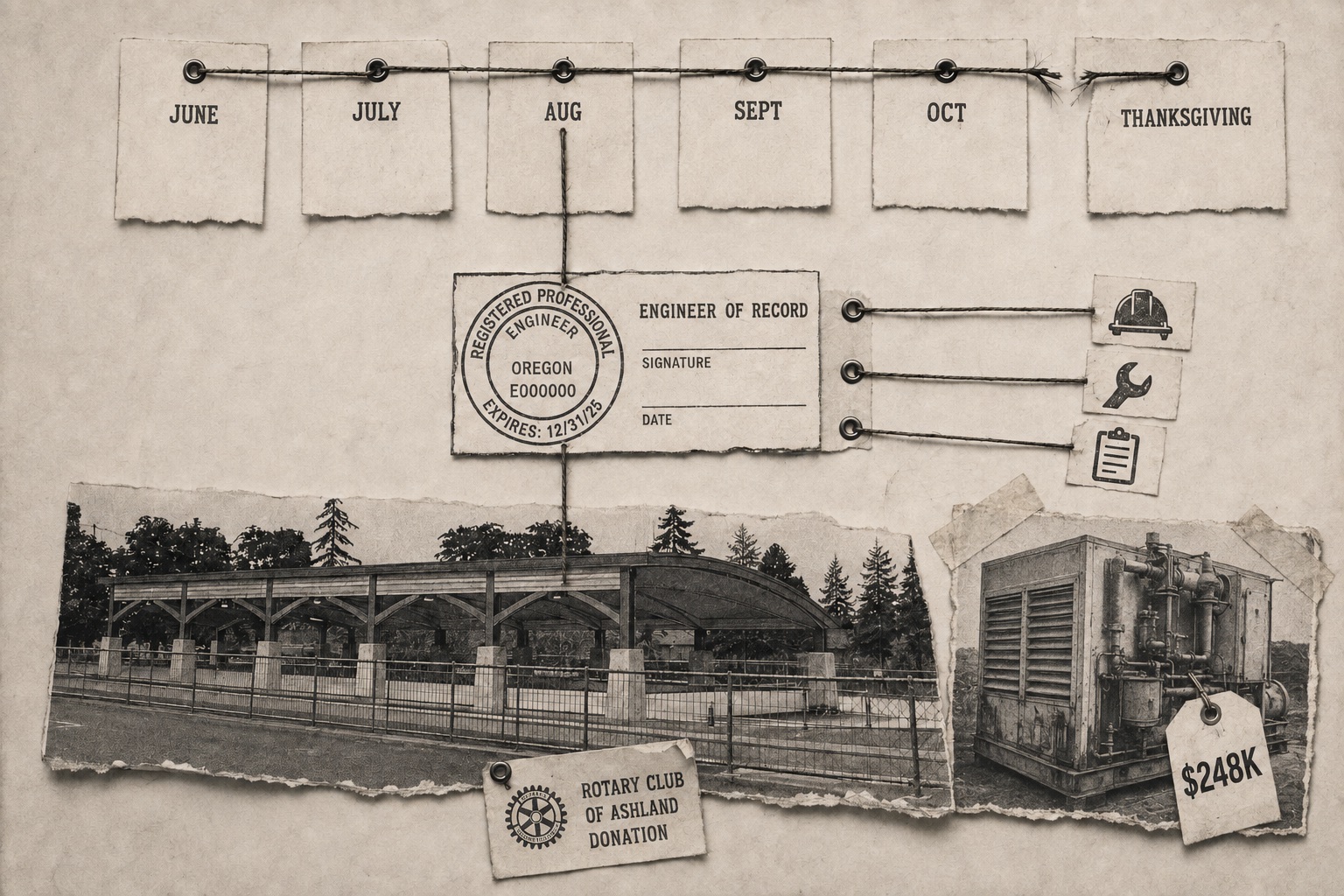
The Ashland Rotary Centennial Ice Rink sat empty on December 19, 2025, inside a canopy nobody was permitted to stand under. The structure was up, and the chiller was paid for. The barrier around it came down in early January, which is how the season officially ended, not with a decision, but with maintenance staff removing the fence from around a thing that was never going to open.
Here is how a town loses a winter.
The Reasonable Thing They Were Trying To Do
Start with the part that reflects well on everybody, because it does exist.
For years the rink cover went up every fall and came down every spring, this cost roughly $100,000 a year. Worse, the market for the work had collapsed to a single vendor: Ashland was, in the director’s own account, “down to only one contractor in the state of Oregon who reluctantly was coming down to still do it.” Reluctantly is the word he used. Anyone who has tried to get a contractor in Southern Oregon will recognize the situation immediately.
So Parks proposed to stop taking it down. Convert the temporary canopy to a permanent structure, save the hundred thousand, stop depending on one unwilling vendor, and this is a good idea. I want that on the record before the rest of it.
The Permitting Cascade, In Order
February 2025: Parks files a preliminary review for the change of use of the canopy. March: planning approval. So far, so ordinary.
Then the requirement that undid everything. To make a temporary structure permanent you need updated structural plans, and in Oregon those plans need the stamp of an engineer licensed in Oregon, and the canopy’s manufacturer had an engineer. Then the manufacturer had staffing problems and laid the engineer off.
Parks was told 60 days to obtain the stamp. They hired an architect to complete the application. They paid a local structural engineer for a special inspection to confirm the bolts and fasteners were still sound. They did, as far as the record shows, each sensible thing available to them.
Meanwhile a clock nobody was watching ran out. Because the canopy had stayed up through the non-use parking cycle, the fire marshal had issued a six-month temporary approval, and it expired October 15. On October 15, staff believed the stamp was imminent and the schedule would hold.
One week before Thanksgiving, on a Thursday, with the director out of the office, Deputy Director Rachel Dials received notice from the manufacturer. The company was in financial trouble and had laid off its structural engineer.
Director Rocky Houston described the department’s response to his commission in one sentence, and I am going to quote it in full because it is the whole case:
“We panicked, started to throw up all of the things that we could to say we’ve got a contract, we’ve got an agreement.”
Panicking is what you do when you don’t have a contingency plan.
Fire Chief Marshall Rasor described what followed with the clarity of a man who has no stake in anyone’s feelings. Absent the engineering stamp, Parks had two options: take the canopy down or not use it. “They chose to leave it up,” he said. “Nobody can be under it. It’s blocked off.” The parking area could not be used for parking either.
And then the line that ought to be carved above the building division door: “It’s unfortunate, but we can’t have a double standard with our permitting.”
He is entirely correct. That is the thing about this story: nobody in it is wrong.
Five Months, One Vendor, No Plan B
This is where the sympathy runs out, and it runs out on a date.
They did not learn about the stamp problem in November. They learned it in June. Houston said so himself: “After we did that back in June, we determined that the manufacturer’s engineer wasn’t, didn’t have an Oregon professional engineer stamp, which is a requirement per Oregon code.”
June. The fire marshal’s temporary approval ran to October 15. That is four and a half months of runway, and the record shows exactly what the department did with it: it asked the vendor how long, accepted the answer: “They said 60 days”, and waited.
Sixty days from June is August. The stamp had not arrived by October 15. Nothing in the record suggests anyone treated the slippage as a warning.
Now the detail that turns an unlucky story into a management story. During those same months, Parks hired an architect to complete the application, and — this is Houston’s own account — “we also completed a special inspection with another structural engineer locally to determine that the structures, bolts, fasteners and all that were still structurally sound.”
There was another structural engineer. Locally. Working for Ashland Parks and Recreation, on this building, on this project, during the window when the entire season hung on obtaining an Oregon engineer’s stamp.
I am not a structural engineer and I will not pretend the handoff is trivial. An engineer stamping a manufacturer’s design assumes liability for someone else’s drawings, and many will decline, and some will want the design re-analyzed from scratch at real cost, and that is a genuine obstacle.
It is not a reason never to ask. And the public record of this project contains no evidence anyone asked, not the local engineer already on site, not a second firm, not a third. There is no request for quotes, no parallel track, no deadline at which the department would stop waiting on a vendor in another state and start paying an Oregon firm to solve the problem. What there is, in November, is panic.
Meanwhile the alternative that would have saved the season was sitting in plain view the entire time. Take the canopy down, put it back up, run the season as a temporary structure the way Ashland had run it for years. Houston costed it out for the commission after the collapse: about 30 days of work, roughly $100,000.
Yes, $100,000 is precisely the sum the permanent conversion existed to save. But consider the trade actually on the table in June: spend the hundred thousand once, keep the rink open, convert next year with the stamp in hand. Instead the city saved the hundred thousand and lost the season, and it did not really even save it, because the architect, the special inspection and the engineering contracts were all being paid for anyway.
By the time anyone ran the take-down numbers it was December, and Houston’s own conclusion was that even if the contractor said yes, the rink would open in late December or early January. Which is to say: the fallback was still technically available in November and had simply been left too late to matter.
The record does not show anyone at the top of that department building a schedule with a decision point in it. No “if the stamp is not in hand by September 1, we take it down.” No second engineer sought, no second vendor. One external dependency, held by a company with financial problems, and a season riding on it.
Bad luck did not do that. Running the project without a spare did.
The Arithmetic Of An Empty Building
Now the numbers, which are where this stops being a procedural curiosity.
In March 2025, explaining to the City Council why parks cuts were going to hurt, staff offered the rink as the example: it costs $426,000 to operate, in seasonal employees and utility bills, against $200,000 in revenue. That gap is the argument for closing it and also the argument for keeping it, depending on whether you think a town is a balance sheet.
In April and May of 2025, before the permit failed, while everyone still expected a season, the parks capital fund paid for a new ice rink chiller. About $200,000 of it hit in April, and the balance came in May. Staff put the total at roughly $248,000.
Two hundred and forty-eight thousand dollars of refrigeration equipment, bought for a rink that then did not open.
By the March 2026 financial update, the revenue chart told the story without commentary: July good, August good, September good, October still good, November flattens, December “significantly lower than 24 and 25.” Staff attributed it to the ice rink, because there was nothing else to attribute it to.
Who Actually Paid
The Ashland Rotary Club put $25,000 into that rink in 2005 and took the naming rights. Club president Ed Finkley came to a January study session mostly to listen, and said so, and then said the thing that makes this more than an accounting problem. The rink cost far more than $25,000. There was, as he understood it, a private donation of about $100,000 that got it off the ground in the first place. He put it alongside the Daniel Meyer pool as an example of the public-private partnerships “that have existed in our community to have the kind of resources that we have.”
He was hopeful, he said, that despite this year’s setback the rink is still part of the parks department and is something that is going to continue.
That is a man whose club’s money is in the ground under a fenced-off canopy, asking politely whether the thing they built is still ours.
At the March commission meeting a commissioner said out loud what the department had not: that he wanted to name, “not for the purpose of pointing fingers,” a couple of failures that year, and that “the failure to open the ice rink was really significant to our community.” He mentioned the towers at the pool and the splash pad in the same breath. It is the closest thing to an accounting the record contains, and it came from a volunteer commissioner rather than from anyone paid to run the place.
The Verdict
Permitting did not kill the ice rink. Permitting is what permitting does, and Chief Rasor gave the only answer his office could give, on the record, while others were giving none. The manufacturer did not kill it either. Companies fail and lay people off, which is why serious organizations do not stake a public amenity on a single one.
The ice rink was lost inside Ashland Parks and Recreation, by a department that knew in June what it needed, was told sixty days, watched sixty days pass, watched a hard October 15 deadline pass, bought a quarter of a million dollars of refrigeration on the assumption it would all work out, and had no second engineer, no second vendor, no drop-dead date and no written fallback when the call came the Thursday before Thanksgiving. Rocky Houston ran that department, and this one is his.
The commission owns a share too. Between June and November the ice rink appears in the record as a status update rather than a risk, and nobody sitting at that table asked the question a bank or a contractor would have asked in the first meeting: what happens if the stamp does not come?
So: get the stamp. Open next season. And on the next capital project that hangs on one signature from one firm in another state, put the decision point in writing on page one, the date at which you stop waiting and start paying somebody in Oregon to solve it. The document is not complicated, shorter, in fact, than a season.
The losses did not land on the officials. They landed on the kids who skate once a year because their families can afford once a year, the Rotarians whose $25,000 bought a name on a building that spent the winter behind a fence, and the volunteer who has to say into a microphone that his own department failed.
Sources: Ashland Parks & Recreation Commission meetings of December 3, 2025, January 7, January 14, February 11 and March 11, 2026; City Council study session of March 31, 2025. Reporting by Ashland.news, “Silence from city fuels uncertainty over Ashland Parks & Rec director’s future,” December 19, 2025, and subsequent coverage, for the fire marshal’s and community development director’s accounts. Figures as stated by staff in open session; quotations as transcribed.