
Civic Beat · August 6, 2026 · by Nixie Worthington
A Mile of Trail, a Hundred-Year Plan
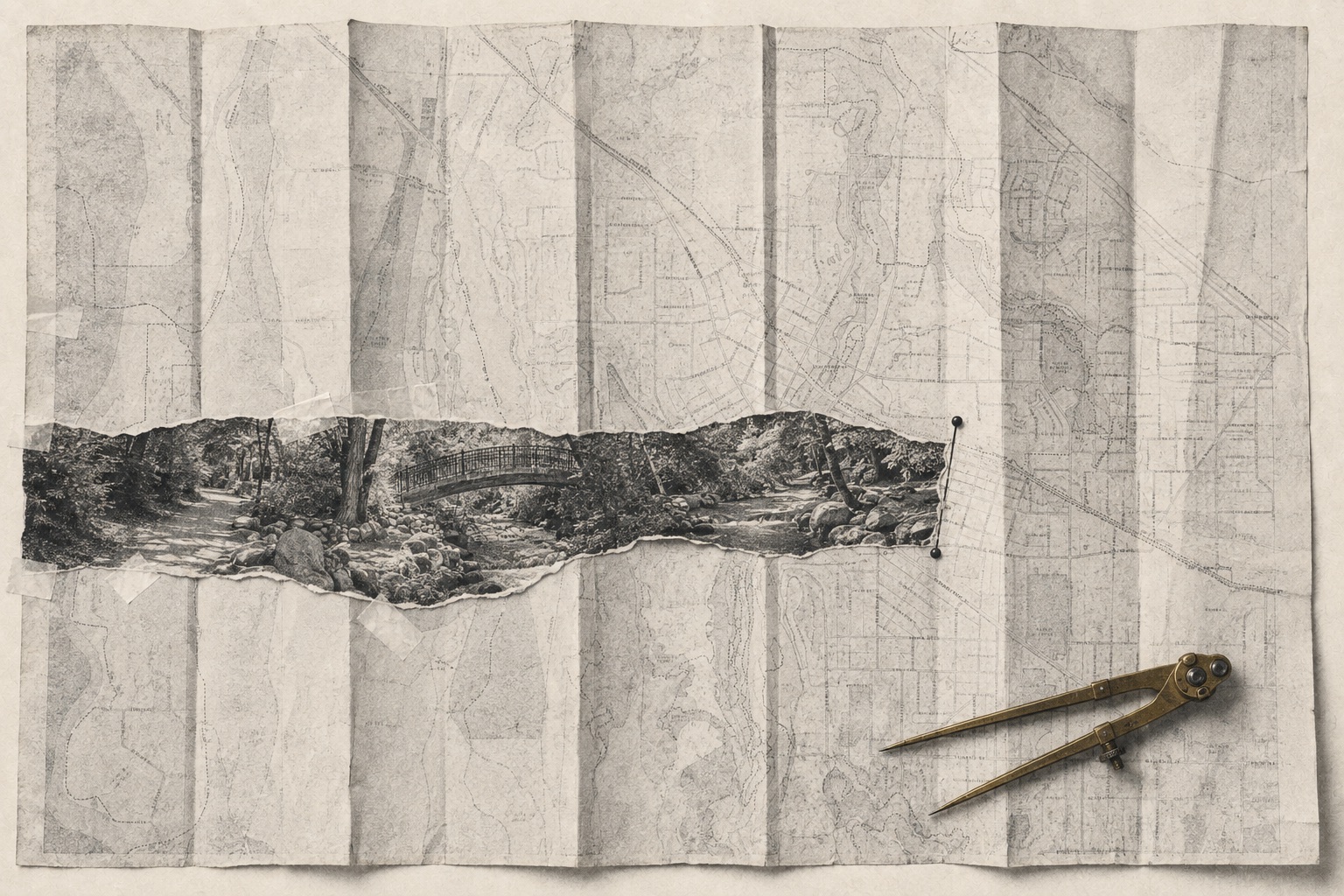
Ashland is about to decide whether bicycles belong in Lithia Park, and on the evidence of Tuesday night, the town has been waiting years for someone to ask.
The proposal on the table is concrete enough to fit in a sentence: just over a mile of mountain bike trail on the East Hillside, a machine-built downhill called Dormouse and a handbuilt uphill route, about half a mile each, at an estimated cost of $30,000, brought forward by the Rogue Valley Mountain Bike Association. Interim director Rachel Dials reported more than 390 public comments received before the meeting began, and offered the institutional measurement that matters: “I’ve been here for I think about 23 years and I don’t recall ever getting that many comments on a parks issue.”
Three hundred ninety comments. For half a mile of downhill. The fire marshal’s capacity limit was invoked twice before the study session even started, the chair gaveled a room that would not stop talking: “that’s the first time that’s ever happened”, and, in the evening’s contribution to civic ritual, banned clapping in favor of “the universal sign language for applause,” jazz hands, with disapproval to be registered as “a stoic silence.” The theater was memorable. The question underneath it is better than the theater, and it deserves to be taken straight.
What Is Actually Being Decided
Strip the two minutes of the twenty-eight speakers down to their load-bearing claims and the trail question turns out to be four questions wearing one vest.
Is there a real gap? The pro side’s strongest ground. Gilad Golan, who owns the downtown bike shop, testified that he fields the question “where do you take kids?” constantly and has no answer: “we don’t have anything in Ashland to serve that at all.” Andy Evans, who coaches youth riders, framed it exactly: “If you’re an experienced rider, Ashland is world class. But if you’re a child, a parent, someone trying mountain biking for the first time, or an adaptive rider there isn’t… an entry point.” Nobody on the other side disputed this. The town that markets itself on outdoor recreation has no beginner mountain bike trail, and twelve-year-old Amber Richards filed the demand side’s shortest brief: “I am fully 100% in like I would totally ride this trail and I would love it.”
Is Lithia Park the place to close it? Here the opposition has documents. John Enders, whose great-grandfather was the first park board president in 1908, and who “might’ve been conceived in Lithia Park”, read the charter language holding that city lands bordering Ashland Creek “shall never be sold, leased, encumbered, or used for any purpose inconsistent therewith.” A retired ecologist’s letter noted the East Hillside’s pine-oak woodland is the only one inside city limits, and that the parks department’s own sign at the trail base warns visitors off trampling the rare plants: “disturbance and trampling would be the inevitable result of this proposal. In fact, they are the essence of the plan.” And Sylvia Iglesias, 78, spoke for “the rest of the million visitors a year” who use the hillside on foot: “what are we thinking?”
Does the trail reduce danger or import it? The night’s two best statistics pointed in opposite directions. Commissioner Adams carried the pro side’s hardest number: “43 motor vehicle versus bicycle accidents in the last 10 years on Winburn Way between Nutley and the plaza versus no bicycle involved accidents on Pioneer in front of OSF”, the argument being that riders will descend somewhere, and the only question is whether the town builds them a route that is not a road. Two speakers supplied the awkward rejoinder that Pioneer is calm precisely because nothing funnels onto it yet. Meanwhile Ian Cropper — born here in 1988, not a mountain biker, “You can check my Strava to verify that” — delivered the structural point that cuts through most of the vibes: bikes already ride these hiking trails illegally, so “this trail won’t stop the bikes. It just keeps them riding where they’re most dangerous.”
Who enforces any of it? Several speakers flagged what the record supports: nobody polices e-bikes in the park now, and nobody at the table explained who would police them on Dormouse. The lone dissenting vote on the Trails Advisory Committee showed up to add that the committee recommending the trail “was basically mountain bikers.”
The Hundred-Year Plan Nobody Can Read
And then there is the document that was supposed to settle all this, which instead produced the evening’s most instructive fight.
The staff slide stated that the Lithia Park Master Plan, adopted October 2024, described as a “comprehensive hundred year management framework”: “recommends against bicycle trails in Lithia Park,” steering mountain biking toward a potential land acquisition next door. Commissioner Adams called the slide “factually inaccurate,” arguing the anti-trail language had been superseded by an addendum. A fellow commissioner contradicted him directly: “The third bullet point was in the addendum, the second bullet point was in the main body. It was never removed… I believe that what’s there is accurate.” Dials, twice, diplomatically: “I’ll check that out.”
Sit with this. The commission adopted a hundred-year plan twenty-two months ago, and on the precise question now before it, bikes in the park, yes or no, the commissioners cannot agree on what the document says, and staff left the meeting promising to go look. A hundred years is going to be a long time at this rate.
There is also the matter of the advocate. The commission’s most sustained voice for the trail is himself a mountain biker whose origin story for the project, by his own telling, involves his own son nearly being struck on Winburn Way. Adams acknowledged the optics sideways: “more than 90% of my time is spent working on topics… that do not involve mountain biking”, which is the kind of statistic one only volunteers when the other 10% is standing at the podium.
Where It Lands
Comments close September 3. Staff returns September 9 with a summary: “hopefully unique individuals and not carbon copies,” the chair requested, and a vote is being teed up, the chair endorsing decisiveness with a Freudian flourish: “at least be ready to vote next week, next month, next month. Yeah.”
The one genuinely falsifiable idea of the night came from Golan: a one-to-two year trial, on the theory that “a trail that’s not being used goes back to nature.” Whether a machine-built downhill in a rare-plant woodland can be un-built quite that gracefully is one of the questions this paper intends to answer properly. The trail fight is bigger than one meeting — it runs through the charter, the master plan, the accident ledger, and thirty years of who Lithia Park is for — and we are giving it the long treatment in our next Sunday Edition.
As Tuesday’s room emptied, the transcript records a single unattributed voice: “Democracy.” Hard to improve on that. We will try anyway, at length.
Sourced from machine-generated closed captions of the August 5, 2026 Ashland Parks & Recreation Commission study session. Quotations appear as transcribed; names are attached only where the chair’s own words or self-identification confirm the speaker. Figures are as stated in open session.