
Civic Beat · February 16, 2026 · by Alan Decault
A Wall The Coach Built
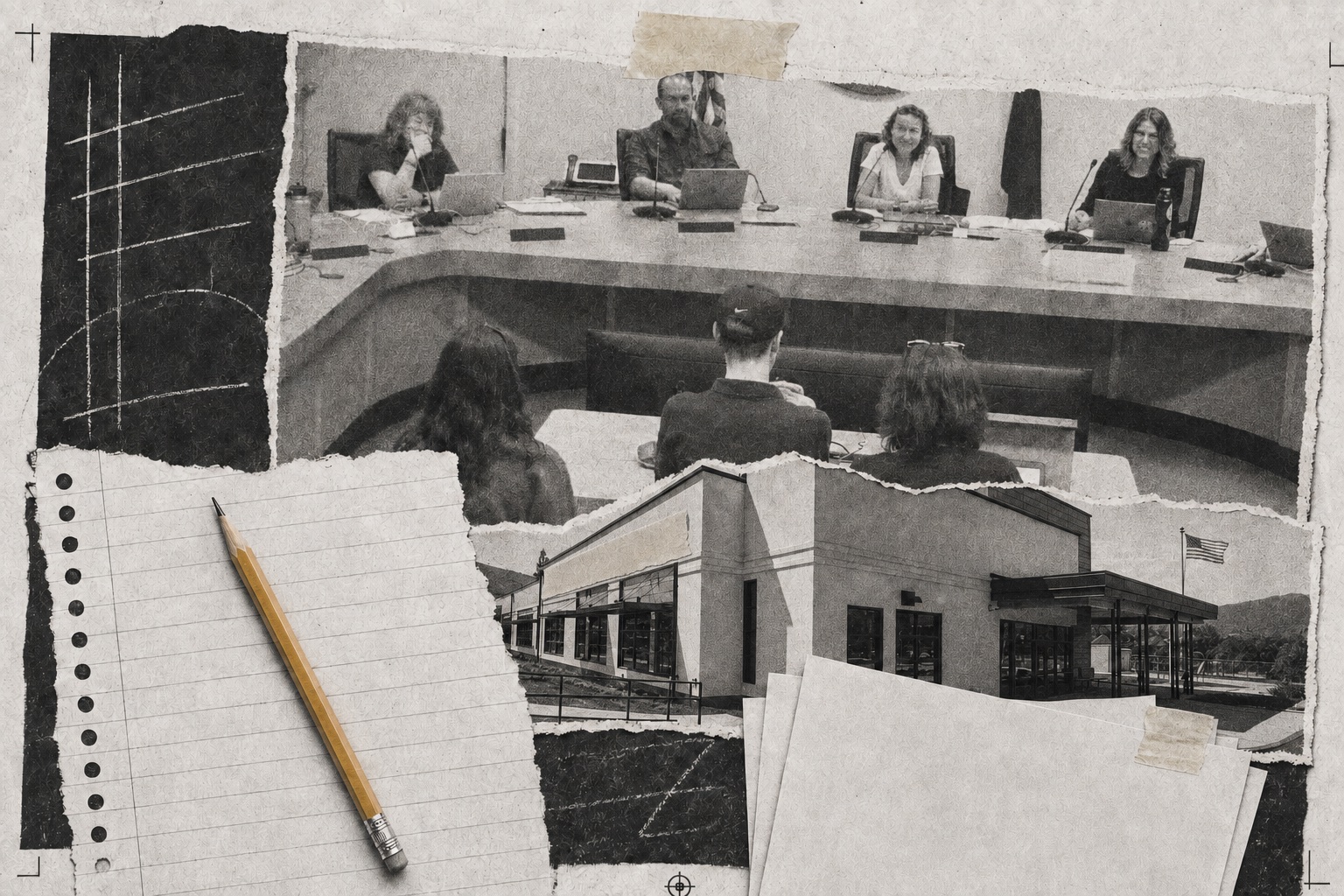
Ashland School Board · February 12, 2026 · 1h 46m · five directors present · one public comment, two speakers.
The most important two minutes of this meeting came at the end, from two people who do not work for the district and cannot vote on anything, and nobody on the dais was permitted to reply to them. That is not a criticism of the board. It is the policy Chair Rebecca Dyson reads aloud before every public comment period, and it exists for good reasons. But it is worth knowing what the rule cost on the night of February 12.
Public Comment
Sojo Blakely and Maggie Hammond, sophomores at Ashland High School, have played softball at North Mountain Park for about six years. They came with a list, and they had organized it: safety, growth of the program, and Title IX.
On safety: there are no lights in the parking lot or anywhere around the field. People sleep in the dugouts and the players cannot see them when they come off a late game. They have called the police non-emergency line more than once. Gear has been stolen from the team room. Someone left a crack pipe in it.
On the program: two fields, one usable, partly for want of players and partly for want of lights. Conflicts with soccer over the same ground. And the part they said carefully, because they clearly knew what it meant: “we also have two girls that we know of who are in eighth grade planning on going to other schools because of our softball program and the safety issues that we have down there at the field.”
On Title IX, three items, delivered flat:
There is no permanent outfield fence. The team plays behind nets, and before every game the coach walks out to confirm the netting is six feet tall, because below six feet the game cannot be played.
The team room is simultaneously a team room, an equipment room and a concession stand that cannot be used as a concession stand. It has no privacy, so, and this is the sentence that ought to be read into the minutes of every facilities discussion for the next two years: “our coach actually built us a wall.”
Baseball has an indoor hitting facility available before games, for bullpens and practice. Softball does not. The batting cage they do have adjoins the Parks and Recreation building where the crews take breaks and store equipment, and is often unavailable. So on Friday doubleheaders the team leaves school at nine in the morning to hit somewhere else, which, as Blakely put it, is “taking away from our education as well.”
They also mentioned, in passing, that they gave part of their team room to Parks and Recreation for storage. That is why the gear is in the concession stand. That is why there was nowhere to change. That is why there is a wall.
Dyson thanked them, noted with evident approval that they know what Title IX is, and said the thing the rule requires: “I’d like to — we’re not allowed to talk. That’s policy.”
This desk has no standing to say what the district should do about a field it does not own, on a schedule it does not control, with money it does not have. What can be said is narrower and is a matter of record: two students described a sex-equity disparity in athletic facilities, on the record, at a public meeting of the body responsible for the program, and the meeting moved directly to the appointment of budget committee members. Whether it returns to an agenda is the only test that matters, and this file will be checking.
The School Presentation: Ashland Middle School
Principal Steve Retzlaff was given, by his own account of the superintendent’s generosity, sixty-five minutes. He used about thirty-two, and the numbers in them are the most complete public accounting of what enrollment decline actually does to a building that this desk has seen.
Enrollment at Ashland Middle School, when Retzlaff arrived twenty-one years ago, was in the mid-700s. It settled in the 600s for years. This year: 463, which is 56 fewer than last year and, he noted, ten more than had been projected. Next year, 448. Three years out, a little over 400, at which point the cohorts coming up from the elementaries suggest it levels off.
The clearest single figure is the handoff to the high school. Last year the middle school sent 193 eighth graders up, and this year it will send 157.
What that has already cost, as presented:
- One of three seventh-and-eighth-grade teams, gone. Two full teams remain, plus a two-teacher “Mountain” team of about thirty.
- The fourth homeroom on each sixth-grade team, gone.
- Last year’s core reductions: half a math teacher, half a science teacher, half a language arts teacher, half a social studies teacher, and a full-time Spanish teacher.
- Encore reductions: a band section, an orchestra section, a PE section, a WAMS section — and the leadership program closed outright, about 1.25 FTE.
- Educational assistant time down thirteen hours a day, roughly two and a half positions.
Retzlaff was careful about the leadership program, and it is the loss he returned to. It was not student council and not an election. It was an encore class every student could take, “the idea was that everybody had the capacity to be a leader.” A student council now exists, fifteen to eighteen students, by application, meeting at lunch. That is a different thing and he said so.
Two findings from the data he showed.
The first is that Ashland Middle School’s language arts scores outperform the state by 22 points and its math scores by 16, and Retzlaff’s explanation for the gap is staffing continuity: the same five language arts teachers for fifteen years, writing their own standards-based rubrics and teaching from them, against persistent turnover in seventh and eighth grade math, where teachers have historically carried four or five preps. The lesson a board might draw is that the thing producing the good number is the thing hardest to buy back once cut.
The second is attendance, and it is bleak. Regular attenders were at 80 percent before the pandemic, level with the state. They fell to 62, then 66, then 68. They are at 72 now, except that in early January they were at 78, and an illness that kept a quarter to a third of the school home for the better part of a week took six points off. Asked whether the children who started school as the pandemic ended attend differently, Retzlaff said it is exactly what you would expect, and that those students are now reaching the middle school.
The Notification
On January 30 there was a student walkout, and the middle school’s attempt to tell parents about it went wrong. The message intended only for the families of students who had left campus, telling them their child was not at school, went instead to all 462 or 463 families.
Retzlaff reported it himself, unprompted, in the middle of a slide about attendance dips, and did not soften it. “The wrong button was pressed.” The person who pressed it “was sick to their stomach about it.” Getting accurate information back out “took much, much longer than it should have.” He named the harm plainly: “that caused a lot of our families some serious distress and unnecessary distress”, said the error had been identified, and called the evening “not our finest moment at Ashland Middle School by any means.”
That is the whole item. It is in this file because a public body being told about its own mistake, in detail, by the person responsible for the building, before anybody asked, is rare enough to be worth recording when it happens.
The Finance Report
Sherry Ely’s first board meeting was a year ago this month. She is the interim business manager and, Superintendent Joseph Hattrick announced, has agreed to stay interim for another year. Dyson’s comment: “interim becomes permanent over time, I guess”, is a joke, and it is also the second consecutive month in which document retention and staff turnover have surfaced in this district’s finances.
The general fund is fine: ending fund balance projected around $3.5 million, about 8 percent, up from last month’s estimate.
The health insurance fund is not fine, and this is the item from the whole evening most likely to reach every employee’s paycheck.
Ashland School District self-insures. Claims are running above what the actuary projected, because hospital and physician costs are rising and a district-sized pool cannot negotiate the discounts a national carrier can, and, Ely noted, sometimes absorbs the difference the carriers negotiate away. A healthy ending balance in that fund, she said, would be at least $1.5 million. Her current projection is $400,000, if the district is lucky.
Asked whether there is a point at which self-insuring stops being an advantage, Ely answered: “To be totally transparent. Yes.” Asked whether anyone is planning for a transition: “Yes… A lot of discussions are going on around that very issue. Can we even afford to do this program anymore?”
Asked whether ending it would be a board decision or an operational one, she said operational, and then said it should come to the board anyway, “if for nothing else, for discussion and transparency.”
Hold that one. The person who says an operational decision ought to go to the elected body before it is made is not always the person holding the pen.
The Word
Under the superintendent’s report, the item titled “consolidation” was renamed.
“As promised, this month begins the regular updates on consolidation, and that is the last time I’m gonna use that word. So I’ve rebranded it to be Transformation… It gives the impression, it gives the wrong impression.”
The process itself is unchanged and was described in some detail: a leadership review of facilities, enrollment history, enrollment projections and staffing, plus a SWOT analysis, running through February, staff engagement in March, family surveys April through June, then in-person listening sessions at each site, and a webpage will carry the documents.
This desk will use the district’s word in the district’s mouth and its own elsewhere, and will note here only that the committee charter, the timeline and the data phase are all the same document they were in January, and that the thing being studied is which schools Ashland can afford to keep open.
Odds
The Southern Oregon ESD’s superintendent, Mark Angle-Hobson, presented the 2026–27 local service plan, redesigned, he asked his communications coordinator to make it “look more like an engaging children’s book”, to show, for the first time, the agency’s budget by division and which positions the plan funds against which are carried by grants. Approved on Rooklyn’s motion, Ruby’s second, five ayes. He also confirmed, in answer to a director’s question, that a student who leaves for an online charter school is not a homeschooler and does not register as one, which is how a district can lose a child without the child appearing anywhere as lost.
The Grow Your Own program, which funds classified staff who want to become teachers, has already been cut once and is “on the chopping block to be eliminated at the end of this year,” pending the legislative session.
The teachers’ union report was, in substance, a single complaint repeated by every school in the district: the conference calendar. Too late in the year to be useful, too close together, two days where three worked. From Helman, the part that is not about teachers at all, a week off “is hard financially for some of our families trying to cover daycare,” and “we are also not supporting food insecurities because some of our families depend on their two meals a day at school.”
The 2026–27 calendar was pulled from this agenda to gather more feedback, and it is due in March.
April Harrison, director of student services, leaves to become superintendent of the Rogue River School District. Dave Dotterer and Serena Robinson were appointed to the budget committee. Work sessions move off Zoom and into the district office conference room, Zoom still available.
The Docket
Work session Thursday, February 26, 6:30, at the district office, the first one in a room. Next regular meeting Thursday, March 12, 6:30, City Council chambers.
Due in March: the 2026–27 calendar, with the conference schedule that every building complained about, and the science and health curriculum recommendations.
Filed for May 19: the board authorized Hattrick to request a ballot title from Jackson County Elections for the renewal of the Youth Activities and Academics Levy. That is the money behind a good deal of what the middle school report described as still standing.
The meeting closed in executive session under ORS 192.660(2)(i), to evaluate the performance of a public officer. No decisions are made there and none were reported.
Sourced from machine-generated closed captions of the February 12, 2026 Ashland School Board regular session. Quotations appear as transcribed, lightly conformed to natural speech, with bracketed interpolations where the repair is interpretive; the caption software recycles speaker labels, so directors are named from the roll and the published agenda rather than from the captions, and are identified by role where the record does not place the words with a person. Enrollment, staffing and financial figures are as presented by staff in open session. Public commenters are named as they identified themselves at the podium.