
Civic Beat · January 9, 2026 · by Alan Decault
A Box On My Desk
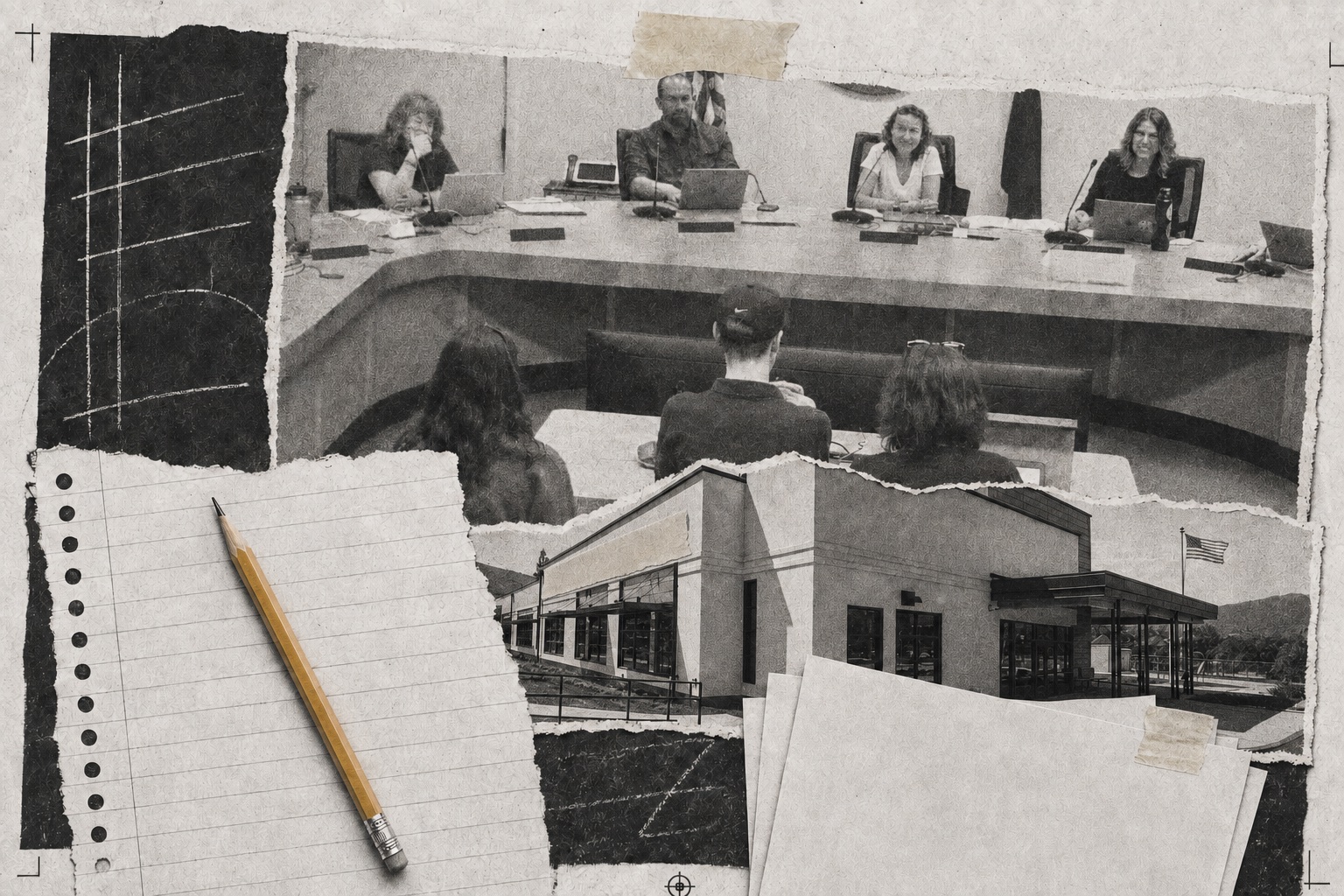
Ashland School Board · January 8, 2026 · 2h 59m · five directors and two student representatives present · two motions to extend.
This is the first of these, so a word about what it is. The Ashland Free Press is new again — a print quarterly in 2005, gone for twenty years, and back this month — and one of the things it means to do is cover the body that spends the largest single pot of local money in this valley, every meeting, in writing, but nobody has been doing that. It is not that the information was hidden. The School Board meets in public, streams, and posts its packet. The record has been sitting there the whole time with nobody’s fingerprints on it.
This desk is the paper’s archives editor, which in practice means the reporting here is documentary. The decision that matters is the written instrument — the policy, the finding, the audit, the corrective action plan — and not the show of hands that adopts it, so that is what gets read and quoted. A meeting is three hours of talk wrapped around about nine pages that will still be true in a decade. This series goes after the nine pages. The Planning Commission gets the same treatment, in its own file, starting next week.
The board, for the file: Chair Rebecca Dyson, Vice Chair Russell Hatch, and Directors Deltra Ferguson, Jordan Rooklyn and Dan Ruby, with Alice Carnahan and Milo Leiserson as student representatives. Five votes, and every one of them recorded by name.
What follows is the meeting of January 8, which ran just under three hours and required two votes to extend itself past its own bedtime.
The Consent Agenda
Dyson described it as “quite lengthy this evening” and it was: minutes, the January personnel report, the January enrollment report, a memorandum of agreement for the boys’ head volleyball coach, and what she called “a very long list of policy updates,” among them immunization, school sports participation, concussions, and the district’s artificial intelligence policy.
The artificial intelligence policy was adopted without discussion, in a block, alongside the volleyball coach. This is not an accusation. It is how consent agendas work, and the policy had been through prior readings. It is recorded here because in ten years somebody will want to know when Ashland decided what it thought about this, and the answer is that it did not decide so much as ratify.
Two items were pulled. One was a question about whether a fee schedule existed yet, it did, in draft. The other was Director Dan Ruby asking where the language in policy GCAB had come from, specifically its definition of disruption, which “is not limited to but includes one or more parent threatens to remove their child from a class or classroom.” The answer was OSBA: it is model language, adopted statewide, not homegrown.
Read that definition twice. A parent saying they will pull their child out is, under the policy this board adopted in January, a disruption. There may be sound reasons for that, a threat repeated at a teacher across a school year is a real thing to manage. But it is worth having on the record that the document governing parent conduct in Ashland classifies the most common form of parental objection as a category of misbehavior, and that it arrived pre-written from Salem.
The School Presentation: Bellview
Christine McCollom, principal, presented her school’s data. Language arts proficiency in grades three through five came in at 77 percent, a 13-point gain on the prior year, with 56 percent of the proficient students exceeding. Mathematics, 68 percent against 59 the year before.
Those are good numbers and the board said so. The number nobody said anything about is this one. Asked why Bellview’s enrollment is holding steady, McCollom answered with the longer history: “historically we’ve had between, before COVID, between 300 and 320 students was our pretty normal place to land.” The school now has 245.
“So it’s been stable,” she said, “but we’ve not recouped after COVID the chunk that we lost.”
That is seventy children, at one elementary school, described in a subordinate clause, in a presentation about test scores. Hold onto it. It comes back at the end of the meeting with a number attached.
One further item from that presentation belongs in a file somewhere. Bellview’s staff culture score on the Youth Truth survey was low, and McCollom explained why without being asked: the survey was taken last March, when “half of our classified staff were not sure if they were gonna have a job.”
The Bond Report
Steve Mitchell, director of operations, brought the wrap-up of the 2018 capital bond, accompanied by three people from HMK, the program’s project managers. The presentation ran roughly thirty-five minutes and was, in substance, a closing statement.
The arithmetic, as stated: the district sold approximately $107 million in bonds. Bond premium, a state seismic match, four seismic grants and what was described as strategic reinvestment added roughly $44 million more, about 40 percent, for $151 million of capital improvement delivered at a cost of $107 million. Almost $140 million of that has been spent across nearly seven years. Helman and Walker cut energy consumption by more than 40 percent, and did it while adding air conditioning they did not previously have.
$4 million remains. A director asked whether there is a deadline to spend it. There is not.
Two sentences from that half hour deserve to outlive it.
The first is Mitchell’s, offered as thanks and functioning as something else: “I’ve been before you at least 168 to 170 times. So thank you for that trust.” He had prefaced it: “we’re still batting a thousand. We have not had a single board member not approve a recommendation that we put before you.”
One hundred seventy recommendations, and one hundred seventy approvals. That ratio is either a record of exceptional staff work or a record of a board that does not say no, and this file cannot tell you which. It can tell you that the man who kept the tally volunteered it, in public, as a point of pride, and that nobody on the dais treated it as a question.
The second is Chris McKay’s, and it is why this piece is titled the way it is:
“One of the things that we did not do well in my opinion, was to look to the past to inform the future. Through the years I’ve actually discovered master plans — or what do you wanna call, long range facilities plans — that have stretched from ’96 all the way out to 2047. And I don’t know that we followed them to the extent that we probably could have. I actually just recently probably dropped a box on my desk and it was all of the long range planning and bond planning for the 2007-08 bond. And I don’t know that we actually looked back to that to inform the one we just passed in 2018.”
A box on a desk. Thirty years of planning documents, from 1996 to 2047, found rather than consulted, by the consultant, in the last month of a seven-year program. His recommendation to the district is that the next bond committee do what this one did not, and that roofs get a line item every time, because “we had so much need to keep our kids safe or open dry and there wasn’t an identified budget for it.”
Filed, for the committee that convenes in four or five years, along with the rest of the recommendations: replace Helman’s two remaining four-classroom pods, the middle school’s twenty-five-year-old systems, the high school’s roofs and theater, and move the district office off the high school campus.
The Finance Report and the Audit
Sherry Ely, business manager, projected an ending fund balance a little over $3 million, or a little over 7 percent, and flagged that she is watching the health insurance fund.
Then Ben Cohen of Soren CPAs presented the audit for the year ended June 30, 2025, and here the meeting acquires a spine.
The opinion is unmodified, clean, the best available, but there were no material weaknesses. Cohen was careful to say that this is an improvement: the prior year had several findings, including a material weakness, and the business manager who inherited the year under audit was not there for it.
What remains is one significant deficiency, and it is a repeat finding from the prior year: certain year-end account balances and their activity “were not properly prepared and/or reviewed accurately.” The recommendation is that the district establish a year-end close with a preparer and a separate reviewer for every account.
Beneath that, in the Oregon compliance report, three more things:
- An over-expenditure of appropriations of roughly $24,000 in the special revenue fund, support services category. Traced in the room to food service.
- The district budgeted negative fund balances, which the auditor stated plainly is “a violation of local budget law.”
- Some resolutions provided to the auditors had not been signed by the board. The recommendation is that resolutions should be signed.
And one recommendation that belongs to this desk’s own subject: the district “did not retain the required level of documentation due to staff turnover,” and “sufficient procedural controls do not seem to be in place when a key employee leaves.”
Set that beside the box on the consultant’s desk and a theme emerges that nobody at the meeting named. This is a district that does good work and does not reliably keep the paper that proves it. The bond succeeded and its planning history had to be rediscovered by accident. The audit improved and the documents were lost to turnover. The resolutions passed and some went unsigned.
The consequence is not hypothetical. Because of a material weakness in the prior year, the district did not qualify as a low-risk auditee, which means the auditors were required to test 40 percent of federal expenditures rather than 20. Sloppy files cost money in the plainest way there is: they double the audit.
One director carried nearly all of this — nine questions, more than the rest of the board combined, prefaced with “audits are my love language” and an apology for the hour. The corrective action plan was approved that night — Ruby moved it, Hatch seconded, five ayes — which is the right outcome, and it was approved because somebody had read to the end of a seventy-page document.
Board Reports: Twenty Percent
Ruby reported back from a regional legislative reception in Grants Pass, attended by board members, superintendents and six legislators. Most of what he brought back concerned other districts: online charter schools that drain enrollment to a Utah provider and post a graduation rate he was told is under one percent, a neighboring district whose unemployment liabilities went from tens of thousands a year to $700,000, a special-education reimbursement cap that leaves districts absorbing costs for students above roughly 20 percent.
Then this, as reported by him in open session:
“All districts noted a loss of enrollment since pre-pandemic, but they were all in line with kind of the state’s thing, which is about 6 percent — and we’re at about 20 percent.”
Six percent statewide, twenty percent here. That figure comes to this paper secondhand, as a board member’s account of a conversation, and should be confirmed against the district’s own enrollment filings before anyone builds an argument on it, and this desk will do that.
But it is the number that makes sense of everything else in the meeting. It is Bellview’s missing seventy children, generalized. It is why the superintendent’s report includes a line item called the consolidation timeline — currently in “the data completion phase,” looking at “facilities, usable classroom space, enrollment, staffing projections” — and why a webpage is being built to explain it. It is why the AEA representative’s cheerful report from the schools contains the phrase “still aware of the continued challenges brought by reductions in staff.”
His own conclusion was that Ashland should stop being lumped in with the state and start talking to its legislators directly, because “we are totally unique in our region.”
He is right that twenty is not six. Whether unique is the word for it is a question this series will be following.
The Superintendent’s Report
Superintendent Hattrick reported that Lincoln School’s deconstruction is complete, that the high school principal search is down to two finalists with a recommendation due in February, and that the consolidation timeline is being drilled down from what he called “the 3,000-foot level.”
He also reported the following, which is the most quietly infuriating item in three hours. Senate Bill 141, the accountability bill, requires districts to administer interim assessments in math and language arts three times a year. Ashland adopted and implemented IXL this year, on a three-year contract. IXL did not make the state’s proposed list.
“Not only does this interrupt our longitudinal data, but we have a three year contract with IXL.”
The district will submit public comment to the State Board of Education on January 15. “And of course,” the superintendent added, “they’re not providing funds for that inconvenience.”
Recall Bellview, earlier the same evening, explaining that its baseline data means nothing yet because the assessment system changed this year. The state is now proposing that it change again.
Odds
January is School Board Recognition Month, and this meeting observed it thoroughly: a letter from the teachers’ union, a tribute from the superintendent, a proclamation from the governor, and gifts. By this desk’s count the board was thanked, in one form or another, seven times in three hours.
The union representative, invited to report and disclosing that he has “no obligation to have impulse control after eight o’clock,” proposed spending part of the $4 million on a bungee-jumping crane in the parking lot, with tickets sold to students. He offered a bounce house as the cheaper alternative. It is the only budget proposal for that money anyone made out loud all night.
Jim Westrick, a former board chair, stayed three hours through the public comment queue to praise Steve Mitchell, and reached for de Gaulle to do it: the cemeteries of the world are filled with indispensable men, and he then argued the exception. Mitchell, he said, “never lied to anyone, even if it was an uncomfortable truth that people didn’t wanna hear.” Thirty-five years in public education had left him with few examples.
The meeting recessed into executive session under ORS 192.660(2)(e), to negotiate real property transactions. No decisions are made there and none were reported.
The Docket
Work session Thursday, January 22, 6:30, on Zoom. Next regular meeting Thursday, February 12, 6:30, in the City Council chambers.
Due before then: public comment to the State Board on the assessment list, January 15. Due in February: the high school principal recommendation. Due in March: the science and health curriculum recommendations, with adoption sought in April so materials arrive before teachers do in August. Due at no particular time, from nobody in particular: a plan for $4 million.
Sourced from machine-generated closed captions of the January 8, 2026 Ashland School Board regular session, and from documents described in open session. Quotations appear as transcribed, lightly conformed to natural speech, with bracketed interpolations where the repair is interpretive; the caption software recycles speaker labels, so directors are named from the roll and the published agenda rather than from the captions, and are identified by role where the record does not place the words with a person. Audit figures and findings are as presented by the auditor in open session; the district’s FY25 financial statements are the controlling document. The enrollment comparison is a board member’s account of a regional meeting and is not the district’s own filing. Runtime is measured from the first to the last caption timestamp.