# Meets Expectations
*The File · August 24, 2026 · by John Stanislaus*
> Ashland's city manager was evaluated in July by seven elected officials, thirty-four staff members and one scoring rubric. The council's own instrument returns 151.6 points out of 250 — an average of 3.03 out of 5, which the form itself defines as meeting expectations. The three things it orders cured come due in November. The clause that protects her job starts in January.
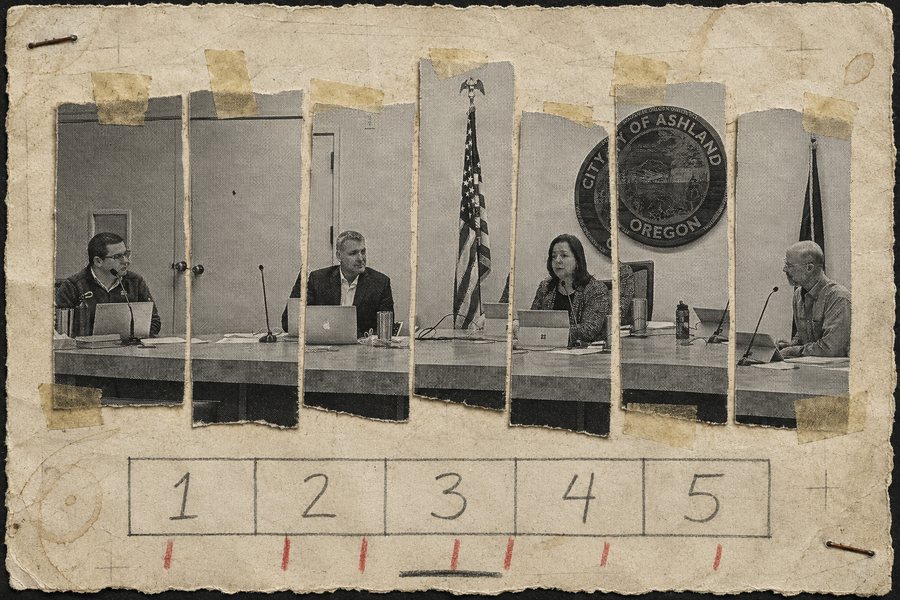
Art by CONTRA — Collage on aged paper: a stack of taped and tabbed personnel files, the top sheet showing a five-box rating scale with the middle box crossed out, flanked by Ashland City Hall in snow, the community center, a gavel, and blank ledger grids, with a dollar bill sliding out of an envelope beneath.
---
An institution reveals itself most completely in the documents it writes about
its own employees. A budget can be argued with. A press release is written to
be disbelieved. But a performance review is a private genre made public by
law, and in it an organization says, without meaning to, exactly what it
values, what it is frightened of, and what it has decided to stop noticing.
It also attempts something no institution is very good at: converting a person
into a number, and then holding the number responsible.
Ashland has just produced one. On July 31, Mayor Tonya Graham signed a letter
evaluating City Manager Sabrina Cotta's performance for the year running July
1, 2025 to June 30, 2026. It arrived with two addenda: a survey of seven
elected officials scored against a rubric of fifty criteria in nine
categories, and a survey of thirty-four staff. The council reviewed the
results in executive session on July 14. The City Attorney, Johan Pietila,
administered the instrument.
Add the council's category totals and you get **151.6 points out of 250**. By
this paper's arithmetic that is an average of **3.03 out of a possible 5**,
and the form supplies its own translation of that number.
Three means *Meets Expectations. Consistently meets expectations.*
That is the whole affair in one figure. A town has spent a year at war over a
woman her own employer scores, on an instrument of its own design, at almost
exactly the mark it labels "meets expectations."
## The Scorecard
Averages flatten things, and this one flattens something worth seeing. The
scores are not uniformly mediocre. They are sharply, almost diagnostically
uneven, and the pattern they make is the most useful thing in the file.
Where Cotta scores well, she scores genuinely well — and where she scores
badly, the subject changes.
Highest and lowest of
the fifty
Council average per criterion · 1 to 5
· dotted line = 3.0, “meets expectations”
Cooperates effectively with neighboring
jurisdictions4.14
Represents the City
effectively in regional and intergovernmental settings4.14
Manages labor relations and
collective bargaining effectively3.85
Maintains organizational
stability, accountability and momentum3.83
Is well-prepared for Council
meetings and work sessions3.71
Recruits and retains competent
personnel for leadership2.60
Implements Council direction
consistent with Council intent2.57
Represents the City with a
positive, consistent, credible public presence2.57
Maintains professional and
trust-based relationships with Mayor and Council2.42
Is responsive to residents,
businesses, and community2.30
Responds well to requests or
advice from Council2.16
Responds constructively to
feedback and shows growth over the review period2.14
Communicates in a manner that
supports transparency and public accountability2.00
Black = at or above expectationsRed
= belowOverall average 3.03
The five highest describe work done with other institutions, with the unions,
or in preparation. The eight lowest describe the job at the point where it
meets a person.
Let's read those two groups again, because the shape of them is the whole
diagnosis. This is a manager who performs above expectations mostly away from
direct public dealing — at the county, across a bargaining table, inside the
machinery, in the preparation that happens before a meeting starts — and below
expectations at nearly every point where the job turns outward to a resident,
a councilor, or a microphone.
> Let's be careful with the word *mixed*. A mixed review is one that cannot make
> up its mind. This council scores her **4.14 with other governments** and **2.00
> on public accountability** — it has made up its mind twice, in opposite
> directions, about two different halves of the same job.
Art by CONTRA
It should also be said that seven people produced these numbers and did not agree with one another. On criterion after criterion, Councilor Bloom records
a 1 while Councilor Sherrell records a 4 or a 5, with the mayor and the rest
strung between them. On one measure — whether she responds well to requests or
advice from Council — the scores run 1, 2, 2, 2, 3, 3, with one councilor
declining to answer. A body that cannot agree within three points on its only
employee is telling you something about itself as well as about her.
The same manager,
graded by seven people
2026 review · each
councilor’s own average across the fifty criteria · all seven returned a
form
Sherrell 49 of
50 scored4.37
Graham
(mayor) 44 scored, 6 blank3.61
Kaplan 50 of 50
scored3.18
Hansen 50 of 50
scored3.16
Dahle 41 scored, 9
blank2.76
DuQuenne 42 scored, 8
blank2.14
Bloom 50 of 50
scored1.92
Spread: 2.45 pointsBlanks
excludedThis paper’s arithmetic on the scoring form
All seven returned a form this year, which is worth saying because a year ago
they did not. The 2025 review used a different and looser instrument — agree
or disagree rather than one to five — and **four of the seven answered it at
all**. On whether the manager provides timely, accurate and complete
information for council decision-making, two agreed, one disagreed, and one
strongly disagreed. Four of the seven graded their only employee; two of those
four failed her; nobody outside the room knew.
That is the more encouraging fact in this file. Whatever else the 2026 process
did, it got every councilor to sit down with fifty criteria and put a number
beside each one, and it produced a document specific enough to be argued with
— including by her.
## The Staff
The employee survey is the part of this file that will surprise the people who
have spent the summer shouting about her, and it deserves to be reported
before anything else in it is used.
Thirty-four staff responded. On **fourteen of sixteen questions, more than 78
percent** rated her performance between adequate and very well. The evaluation
letter records that the numbers "remain high across all 16 questions," and
Council writes plainly: *Your staff trusts you and that matters to the
Council.*
The free responses go further than the numbers do. One writes that Cotta "has
and continues to be the stability that staff and the City has needed for
years." Another, that she is "the strongest leader the City has had in at
least a decade." A third: "I don't know if I would still be at this
organization if not for her." A fourth describes a manager who "listens,
supports process improvement where appropriate, has provided resources for new
technology implementation, and invests in professional development." These are
not the notes of a workforce being tyrannized.
Two questions break the pattern, and Council flagged both.
**Seeks input from affected departments before making decisions that materially
affect their work — 27 percent disagree.** **Creates an environment where staff
can raise concerns, identify problems, or offer dissenting views without fear of
retaliation or negative consequences — 25 percent disagree.**
Art by CONTRA
Council's letter calls these "indications of internal culture and as such, are very important," and orders both to reach 80 percent agreement by the 2027
evaluation. One in four people saying they cannot safely disagree with the
person who signs off on their pay is the sort of number a careful reader stops
at. Let's stop at it.
And beneath it sits the specific institutional failure this file returns to
repeatedly: **Human Resources.** Staff comments describe an HR department
perceived as "unresponsive, directive rather than collaborative, and
unprofessional," one the same respondent says the City Manager's oversight
"allowed" to "foster an atmosphere of hostility, inconsistency,
unprofessionalism," and a broader "lack of trust in HR and the City Manager,
with some employees hesitant to raise issues due to fears of retaliation." One
respondent notes that "concerns about the anonymity of this survey have also
discouraged participation," which is a sentence a serious organization should
read twice.
Council's own language is unusually blunt for a document signed by a mayor:
> "That so many management staff are sharing significant concerns about the HR
> Department is particularly problematic given the **heightened legal risk**
> poorly handled HR issues pose to the City of Ashland."
The letter then does something more damning than any criticism from a podium.
It notes that Council had already planned, at the *2025* evaluation, to coach
the HR Director toward independence from the City Manager's office; that some
progress has been made; and that "concerns regarding competence,
professionalism, and favoritism remain." Then this: the fact that HR
leadership "did not independently identify the need for a standard employee
review process illuminates the concerns of competence."
An HR department that had to be told it needed a standard employee-review
process. This is the operation for which the City of Ashland budgets a
director at **$160,349 in wages and $95,540 in benefits.**
## The Cures
Art by CONTRA
The word the letter uses is *cure*, and it uses it as a heading: **Issues to
Cure.** Three of them, each with a mechanism, a threshold and a date. Whatever
else this document is, it is not a pat on the head.
**One: reform of HR.** A plan due **August 18**, carrying its own 90-day timeline, and ninety days from that presentation to put its steps in motion — the same ninety days, ending in mid-November. Then a follow-up survey to the
same staff, and — the test — **75 percent must agree** that the operation and
trust of the HR department is adequate or improving significantly.
**Two: strategic communications.** A plan due **August 18** naming the person
responsible for strategic communications and for tracking community conversation.
Thirty days to implement, so the actions must be in place by roughly **September
17**; an outcome assessment at ninety days, at which **a majority of the seven
councilors must find significant improvement.** The letter lists its exhibits
without euphemism: the move from City Hall to the community center, the
trespassing situation at the community center, and — as examples of an
"unwillingness to consider changing course" when the community objects —
increased use of herbicides and the redesign of street medians.
**Three: council engagement.** Over **108 days** from August 18 — so through
about **December 4** — Council requires visible improvement in four specific behaviors, every one of them startling to see written down about a chief executive: a respectful approach to the role of Council; **responses within three
business days** to council requests for information; "maintaining professional
decorum in interactions with council members"; and **reducing the number of
cancellations of one-on-one meetings** with councilors.
To its credit, Council commits to four obligations of its own in the same
passage, including reviewing packet materials, asking questions before
meetings, and "maintaining professional decorum in interactions with you." It
also installs a tripwire: an unprofessional interaction reported in either
direction "will trigger a neutral, third-party investigation."
> A city manager who must be instructed, in writing, to return a councilor's
> question **within three business days** is either being harassed or is not
> managing. The file argues both, on the same page.
Two of these three issues were raised in the 2025 evaluation. The letter says
so itself. This is the second year of the same instruction.
## What Happens to a Measurement When You Aim at It
Now let's watch what the letter does at the moment it turns serious. It stops
describing and starts specifying: **80 percent** agreement by the 2027
evaluation on the two staff-culture questions; **75 percent** agreement that
HR is adequate or improving; a **majority of seven** finding significant
improvement in communications.
Every one of those numbers began life as a measurement and has now been made a
target. Until July 31, the staff survey was an instrument for finding out what
was true inside the organization. As of August 1 it is the thing the
organization is required to move. This is the oldest problem in management and
one of the more reliable findings about human institutions: a measure adopted
as a goal stops measuring what it measured. The ward hits its wait-time target
by counting differently. The classroom raises the test score without raising
the education.
There are only so many ways to move a number like this one, and only one of
them is to fix what the number was about. The others are to change who is
surveyed, to shape the conditions under which people answer, or to make the
cost of a dissenting answer quietly clear — in an organization where a quarter
of staff have just reported they do not feel safe dissenting, and where one
respondent volunteered that "concerns about the anonymity of this survey have
also discouraged participation."
None of which argues for abandoning the thresholds. The alternative — *improve
communications*, unnumbered and unfalsifiable — is how the 2025 evaluation
failed to resolve the problem and had to be written again in 2026. Council
chose a real instrument over a comfortable one, and that was the right call.
But it bought a known risk, and it should say so out loud when the results
come back in November: that a survey used as a test measures partly the thing,
and partly the pressure applied to the thing. The honest reading in November
will require asking not only whether the number moved, but who was asked, and
what it cost them to answer.
## The Raise That Arrives By Itself
Now the sentence nobody in this town has argued about, which is the one that
deserves it.
Cotta's employment agreement, section **4.3.6**, reads: *Upon the successful
passing of the Employee's annual performance review in July, the Employee will
automatically be moved to the next step on the salary schedule.*
Automatically. And the contract, having made a payment depend on the word,
never says what the word means.
Contracts are written in a language that pretends every term has an owner.
*Malfeasance* is defined in this one, at length, in its own subsection. *Core
employment policy* gets a definition. *Successful* gets none. It is left to do
its work as though everybody knows a successful review when they see one —
which is precisely what a document should never assume about the sentence that
moves money.
So let's go looking for it in the letter. There is praise. There is a list of
accomplishments that runs to fourteen items. There are three issues to cure,
with deadlines, thresholds and a tripwire for third-party investigation. One
can read the thing twice and not find the sentence that says whether she
passed.
So the public record leaves an unanswered question with a dollar figure
attached, and this paper will state it plainly rather than guess: **did the
July 2026 evaluation trigger the automatic step increase in section 4.3.6, and
if so, on what finding of success?** The city has not said. It should,
unprompted, and in public.
For scale: the 2026 budget carries the City Manager at **$216,803 in wages and
$116,075 in benefits — $332,878** in total budgeted compensation. That is
roughly a third of a million dollars a year for a position the council's own
rubric scores at 3.03, in a city that spent the spring adding a $5.15 parks
fee to utility bills and telling residents the senior center was at stake.
None of which makes her overpaid by the standards of the market she was hired
from. It makes the sequencing indefensible, and the sequencing is a council
decision, not hers.
## The Clause
Every document in this file eventually runs into the same clause, and it is
worth reading slowly, because the half of it everybody quotes is not the half
that governs.
Section **3.4** of the agreement: *The City shall not terminate the Employee
within 180 days after the swearing-in of newly elected Council members, except
for violation of any criminal law, core employment policy, or for
malfeasance.* And then the part that changes the analysis: *In the event the
Council chooses to terminate during this period the Employee will be granted
**double** the Severance Pay.*
So the clause does not lock the door. It puts a number on the handle.
The severance itself, under section 3.3, is **twelve months of base salary**,
plus accruals, plus twelve months of deferred compensation at the maximum IRS
contribution, plus a healthcare stipend equal to twelve months of employer,
employee and family premiums — paid as a lump sum within thirty days, with
ninety days' notice. Doubled inside the protected window, the base-salary
component alone runs past **$433,000** before anything else is counted.
Three council seats are on the November ballot. New members are sworn in at
the council's first meeting in January. **One hundred and eighty days from a
swearing-in in early January runs to roughly the first week of July 2027.**
Now let's lay the two calendars beside each other.
The cure deadlines fall in **mid-November and early December 2026.** The
protected window opens in **January 2027.** The council that wrote the cures
is the council that will read the results — and it will read them in the last
weeks of its own existence, with the answer in hand and four or five weeks to
act on it before acting gets twice as expensive for six months.
> The sitting council set itself a test with a due date, then handed its
> successor a contract that doubles the cost of acting on the result for six
> months. Nobody laid that trap on purpose. It is what happens when a body writes
> deadlines into one document, signs another, and never lays the two side by
> side.
## The Person
It is possible to hold all of that in one hand and still be fair, and the file
insists on it.
Sabrina Cotta did not arrive at a functioning organization. She was deputy
city manager, then acting, then interim, then permanent, across an era in
which this city cycled through managers, finance directors and attorneys fast
enough to embarrass a minor-league franchise. She has been, at various points
and sometimes at once, interim HR director and interim finance director. A
staff member puts it better than a columnist could: the public does not
"understand the breadth of her positive impact and foresight as Interim HR
director, Interim Finance director, Deputy CM and Interim CM before her
appointment."
The record also contains something the town should sit with. One staff comment
observes that "much of the vitriol directed at Sabrina by some members of the
community is thinly-veiled misogyny that goes way out of bounds," and that
Council has a responsibility to name it rather than let it pass. Another notes
she has absorbed "an unusually high level of public criticism over the past
year, much of it personal in nature," and shielded staff from it. A third, on
the survey Council itself commissioned: "nothing Sabrina has done warrants the
level of critical scrutiny that is being performed on her right now (even with
this survey)."
That is a real finding in a public document and it is not cancelled by
anything else in this piece. A person can be miscast in a role and still be
owed decency in it, and this town has not consistently managed the second half
of that sentence.
One more, from a staff member who is plainly not a partisan: that running a
small city like Ashland "is one of the hardest jobs on the planet." Read the
rest of the file and the claim looks less like flattery than like a job
description. Ten departments' worth of expectation, a council that cannot
agree on a 1-to-5 scale, a structural deficit, a closed City Hall, and a
public that has learned to conduct municipal argument at the volume of a
divorce.
## The Assessment
So, let's give this an honest reading, which is what this section is for.
On operations, the evidence supports her. Phase one of the water treatment
plant complete; the community wildfire protection plan adopted and over three
hundred residents through the city's first evacuation drill; fifty-plus
fire-resistant poles in the ground; the facilities study finished; six lots
land-banked for affordable housing; a manufactured home park zone drafted; the
comp and class study completed. Staff report stability where there was churn.
Labour relations score 3.85 from a council that scores her 2.00 on
transparency. The machine runs.
On the parts of the job that are not operations, the file is unsparing, and
this desk agrees with it. The council-manager form does not hire a chief
operating officer. It hires the one professional whose task is to convert a
legislature's intent into administration and to explain the result to the
people paying for it. Measured there, the record shows a manager who
implements council direction inconsistently with council intent (2.57), does
not respond well to council advice (2.16), does not communicate in a way that
supports public accountability (2.00), and — the number that should worry her
advocates most — **does not respond constructively to feedback or show growth
over the review period (2.14).**
That last figure is the one that decides the question, because everything else
in the letter is a request to change, and 2.14 is the council's assessment of
how much changing it has actually seen so far. Two of the three cures were
already ordered in 2025.
Let's try it the other way round, as a test of our own fairness. Strike the
name from the file, strike the town, and hand the pages to someone who has
never heard of any of this. They would find an executive rated above
expectations at operations, labor relations and intergovernmental work, and
below expectations at transparency, public responsiveness, council relations
and growth. They would not conclude that this person is a scoundrel. They
would ask why an organization had assembled those two halves into a single
job, and then hired for one of them.
The fair conclusion is not that Sabrina Cotta is a bad public servant. It is
narrower and harder: **she appears to be an able administrator who has not, in
two evaluation cycles, demonstrated the political and communicative half of a
job that is at least half political and communicative** — in a town where that
half is the whole controversy. That is a question of fit and of demonstrated
growth, not of character, and the difference matters, because a town that
fires people for being disliked will get managers who are pleasant and
useless.
If the November surveys come back showing the cures took, the council will
have been right to try. If they come back showing what the last two years have
shown, then the council will know, in the first week of December, that it has
an executive whose own employer rates her below expectations on the central
public-facing functions it measured — and four or five weeks to act before
acting costs double.
## What Should Happen
Publish the answer to section 4.3.6. Whether the review was "successful," and
whether a step increase followed, is a matter of public money and takes one
sentence.
Put the November results in front of the public. The cures were ordered on the
strength of surveys the public has now read; the results of those surveys
belong in the same place, in open session, with the thresholds — 75 percent on
HR, a majority of seven on communications — reported against as written.
And decide in December rather than in January. Not because a departing council
should punish anyone on its way out, but because the alternative is to hand
the decision to a body that will face double severance for making it until
roughly July — about a manager whose cure order expires before that body is
sworn in. The constraint is contractual, not constitutional, and it is a price
rather than a prohibition. It is still a price the incoming council did not
set and cannot avoid. Whatever this council concludes — that she cured it, or
that she cannot — December is when it will know, and December is when it
should say so, in public, on the documented record.
## The Middle Box
Art by
CONTRA
Let's finish where the instrument does.
The form gives five boxes. One is Unsatisfactory. Five is Outstanding. Fifty
times over, seven people sat with those boxes and put a mark in one of them,
and when somebody added the marks up and divided, the answer came to rest in
the middle box — 3.03 — the one the form calls *Meets Expectations*.
Consider what had to be squeezed to fit in there.
Into the middle box went the woman who took the acting job in November 2023,
in a city that had recently mislaid a manager, a finance director and an
attorney, and who did not put it down. Into it went thirty-four people, a
clear majority of whom say she steadied a place that had not been steady in
years, and the nine of them who did not answer the question at all. Into it
went the staff member who wrote that she would have left the organization by
now if not for her, and the one who called the whole operation elitist and
secretive. Into it went a councilor who marked her 1.92 across fifty criteria
and a councilor who marked her 4.37 — two people describing the same twelve
months in the same small town, two and a half points apart. Into it went a
wildfire plan, an evacuation drill, fifty fire-resistant poles, a treatment
plant halfway built, a closed City Hall, an occupied community center, a
herbicide map, a quarter of a workforce that does not feel safe disagreeing
with the boss, and eighteen months of a woman being shouted about, by name, in
the town that employs her.
All of it went in, and the box came back marked *adequate*.
That is not the instrument failing. Compression is what instruments are for,
and this one is a considerable improvement on the four-person shrug it
replaced. But a number is a decision about what to stop looking at, and a
council that has agreed to stop looking is a council that has to be very sure
it looked properly first. Twice now, on the same three problems, it has
written down that it was not sure.
And one thing the form has no box for at all.
At some point during this tenure — the record does not fix the month, and the
city has never volunteered it — the manager of the City of Ashland moved her
household out of Ashland and up the highway to Medford. There is no residency
requirement in her agreement. There are entirely human reasons to live in
Medford, beginning with what the same paycheck does to a mortgage twenty
minutes north, and Medford is a decent city whose own manager lives in it.
This paper reported the move in August and does not begrudge anyone their
house.
But set that fact beside the fifty criteria and it explains their shape better
than any one of them explains itself. Look again at where the numbers are
high: the county, the bargaining table, the regional room, the
intergovernmental call — the parts of the job conducted at a distance, with
other professionals, at arm's length from anybody's kitchen. Look at where
they collapse: transparency, public accountability, responsiveness to
residents, credible public presence. Distance is where she is strongest.
Proximity is the part of the office she has been graded on and found short.
So the last line of the file is one the file never wrote down. The public
safety fee, the wildfire fee, the parks fee — the charges this administration
defended through a year of open warfare, the ones a town was told stood
between it and its senior center — arrive on Ashland utility bills. Hers is
not one of them. She argues the case in the evening and is not billed for the
verdict in the morning. That is lawful, it is ordinary, and it is not a
character flaw. It is also the single most eloquent thing in this entire
record about why a woman who is good at this job keeps scoring two out of five
at the part of it that faces us.
So the file stays open, which is the condition this town is actually in. The
letter of July 31 will still be in a drawer in twenty years, and it will read
then exactly as it reads now: a governing body that took fifty tries to decide
whether the person it hired was doing the job, could not agree within two and
a half points, and gave itself until November to find out. In the first week
of December it will finally know something. Everything up to that point is
already written down, initialed and filed. What happens after it is the only
part of this that is not.
---
*Sources: the City of Ashland's July 31, 2026 city manager evaluation letter,
signed by Mayor Tonya Graham; the 2026 council performance scoring form with
individual councilor ratings and category totals; the 2026 staff survey for the
city manager review (34 respondents, 16 scored questions and three free-response
questions); the 2025 city manager annual review survey; the City of Ashland
employment agreement with Sabrina Cotta dated October 1, 2024, in particular
sections 3.3, 3.4, 3.5, 3.6 and 4.3.6; and the city's 2026 total budgeted FTE
schedule. All are records of the City of Ashland released under Oregon public
records law and circulating publicly. Category totals, the 3.03 average, the
severance arithmetic and the 180-day date are this paper's arithmetic on those
records and are shown so a reader can check them. Staff comments are quoted as
written and are anonymous in the survey as released; no attempt has been made to
identify respondents. The Medford residence is as reported to this paper and referenced in public
comment; the city has neither confirmed nor disputed it, and no residency
requirement appears in the posted agreement. The question of whether the
evaluation triggered the step
increase under section 4.3.6 was unanswered in the public record at the time of
writing.*
Source: https://ashlandfreepress.com/the-file/2026-08-24-meets-expectations